
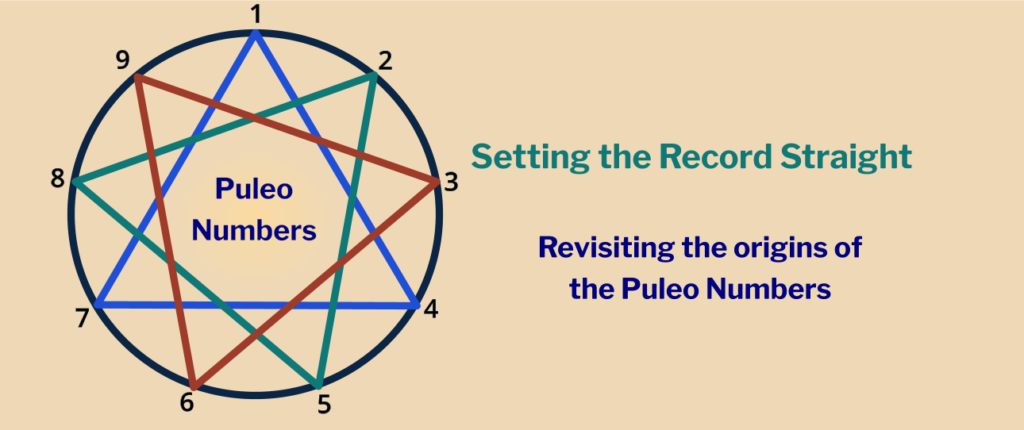
Setting the Record Straight
Revisiting the origins of the Puleo Numbers
“Truth can never contradict truth.” — Galileo Galilei
Every investigation begins with a question. To understand the origins of the frequencies now called “Solfeggio,” I went back to their earliest publication—The Healing Codes for the Biological Apocalypse. I found inconsistencies between the text, the music, and the mathematics. This article clarifies those points and restores the discussion to its proper foundation in sound, interval, and harmony.
When one wants to test whether information is true, the best place to begin is with the source material and bibliography offered as proof. In this case, I went back to The Healing Codes for the Biological Apocalypse by Leonard G. Horowitz and Dr. Joseph Puleo.
The first thing that stood out was a quote from John Keely:
“The vibrations of thirds, sixths, and ninths were extraordinarily powerful.”
Dr. Puleo translated this into the numbers 3, 6, and 9 — yet these are clearly musical terms, not numerology. Keely was speaking of harmonics:
“In all molecular dissociation or disintegration … a stream of vibratory antagonistic thirds, sixths, or ninths, on their chord mass will compel progressive subdivision. In the disintegration of water, the instrument is set on thirds, sixths, and ninths to get the best effects.”
The terms thirds, sixths, and ninths describe musical intervals. A musical third equals 5/4, a sixth equals 5/3, and a ninth equals 9/4. Combined with the “chord mass of water,” Keely suggested that sound could influence molecular separation — not that 3, 6, or 9 were mystical numbers.
Next, I questioned the tones themselves. Many fall outside the normal human vocal range — difficult for men to sing and high even for trained women’s voices. See my article on the “Nine Puleo Tones and Seals” to hear the tones.
Dr. Puleo also cited Professor Willi Apel, who noted that the modern Gregorian scale differed from the original Ut–Re–Mi–Fa–Sol–La system tied to the Hymn to John the Baptist. From this, Dr. Puleo concluded that these six tones must be the original “Solfeggio” notes. Yet the musical term solfeggio simply means solmization — assigning syllables to notes of the diatonic scale: Do, Re, Mi, Fa, Sol, La, Ti, Do.
For a deeper analysis, see my article “It’s Way Past Time.”
Finally, I revisited the third biblical clue: the Songs of Degrees (Psalms 120–134). Each begins with that phrase, forming a repeating 15-step structure — a pattern that Dr. Puleo attempted to align with a 13-note octave by removing two lines. But a true clue cannot be altered to fit a theory.
In the end, I had several inconsistencies:
- The “Degree key” solution did not hold logically.
- The tones did not form a singable musical scale.
- Keely’s “thirds, sixths, and ninths” referred to musical intervals, not numbers.
- The 528 claim for DNA repair lacked scientific verification.
These inconsistencies began my search to decode the clues myself.
This is where I begin setting the record straight.