
The Solutions
Numbers, Letters, and Music
Three clues. One structure.
“If the clue exists, then the solution exist.” — Delores DeVore
The numbers and the music reveal a coherent structural system. The letters, through Gematria, provide an additional layer of meaning without functioning as part of the musical structure.

The Three Solutions
Numbers: The framework
The first clue leads to the repeating set of numbers found in Numbers 7:12–84 of the King James Bible. This solution is the only one publicly attributed to Dr. Joseph Puleo, whose work appears in ‘The Healing Codes and the Biological Apocalypse’ by Leonard Horowitz and Dr. Puleo. In the 72 verses of Numbers 7 beginning with verse 12, Puleo identified six numbers that repeat four times each: 396, 417, 528, 639, 741, 852. The three hidden numbers are 174, 285, and 963, if not known before publication, were discovered shortly after the book’s publication. Since then, all nine have appeared in Sound Healing and Tuning Fork Therapy for more than 25 years.

However, the meanings currently assigned to the nine numbers are based on a Latin hymn—’The Hymn to St. John the Baptizer’. These meanings were mistakenly paired with the wrong notes and are therefore incorrect. See my article: ‘It’s Way Past Time to Set the Record Straight’.
Patterns in the Numbers Themselves:
The Digital Root:
Table below shows the Digital Root (3, 6, or 9) for The Puleo Number, the Reverse Puleo Number and the Triple Number.
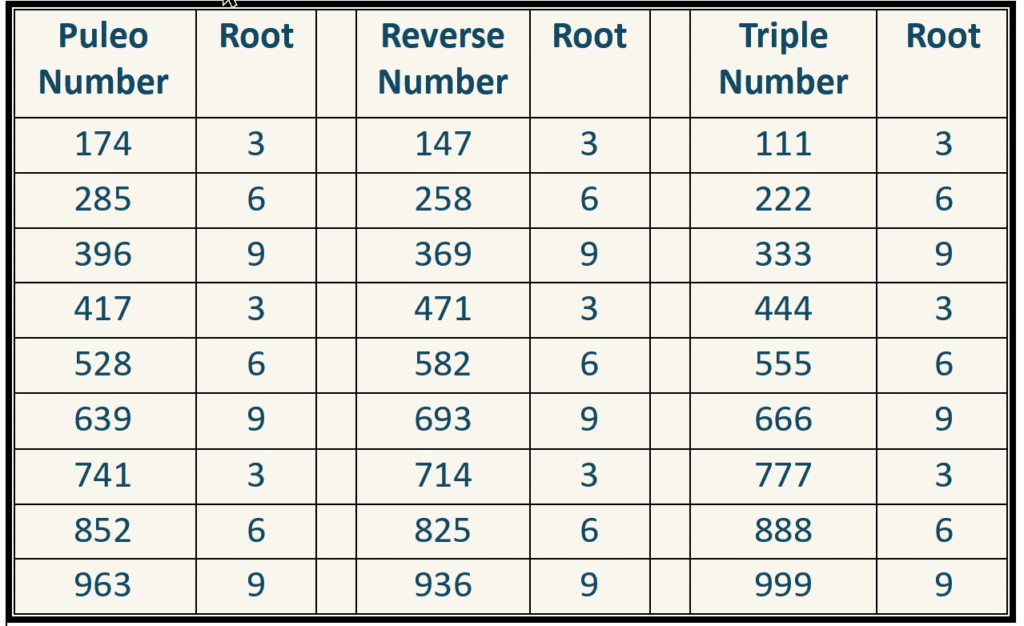
Digital roots reduce to the repeating pattern 3, 6, 9.
- Verse 12 → 1+2 = 3
- Each offering spans 6 verses
- Total verses: 72 → 7+2 = 9
Reverse Numbers:
Reverse numbers are derived by reversing the digits (e.g., 396 → 693). They are then sorted to put into numerical order. The Reverse Numbers are part of the 3-6-9 series. (See table above)
Reflections- Reverse Numbers:
I have not found that these numbers are needed to solve the Mystery of the 3 clues but are given here to acknowledge their existence and know that many ciphers use Reversals as a code.
Triple Numbers:
Triple numbers are produced by subtracting each original number from 963 using Pythagorean math, generating 111 – 888; 999 is included by association. This series of numbers also belongs to the 3-6-9 series.
Reflections Triple Numbers:
Again, I have not found the triples are needed nor used to solve the Mystery. They are included because they are derived from the Original set of numbers.
Reflections Summary:
This recurring pattern of 3, 6, and 9 appears in multiple forms. Its presence raises questions about whether these relationships were intentionally encoded.
Defining the set of numbers:
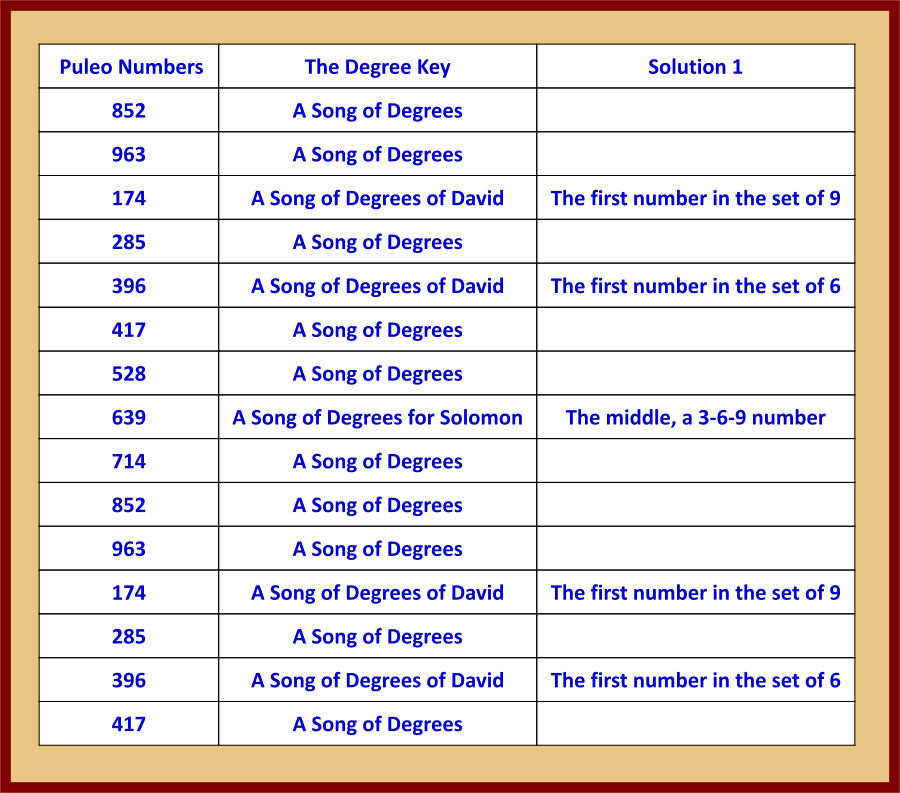
By extending the numbers both above and below the original number set we can match the third clue with the numbers.
The middle line “A Song of Degrees for Solomon is a 3-6-9 number and that becomes our anchor point.
Match up the Different Phrases;
The first line that is different (“A Song of Degrees for David”) aligns with the first of the nine numbers. (174).
the second different line (again, “A Song of Degrees of David”), aligns with the first of the 6 note set. (396).
Then we have the middle line (“A song of Degrees for Solomon”) with a 3-6-9 number for the third different line. (639).
The fourth different line (again, another (“A Song of Degrees of David”) that matches the first number in the set of nine. (174)
and the fifth different line (A Song of Degrees of David”) matches the Frist number in the set of six (396).
the pairing of Phrases to the numbers 174 – 174 yields the set of 9 numbers.
The Pairing of phrases to the numbers 396 – 396 yields the set of 6 numbers.
Reflections:
This paring of the nine numbers with the degree clue is new Information.
It tells me these are the two set of numbers that are needed and no other.
This first clue establishes the numerical framework and confirms that only the sets of six and nine are required. The next clues determine how these numbers are meant to be read.
Letters: The meaning
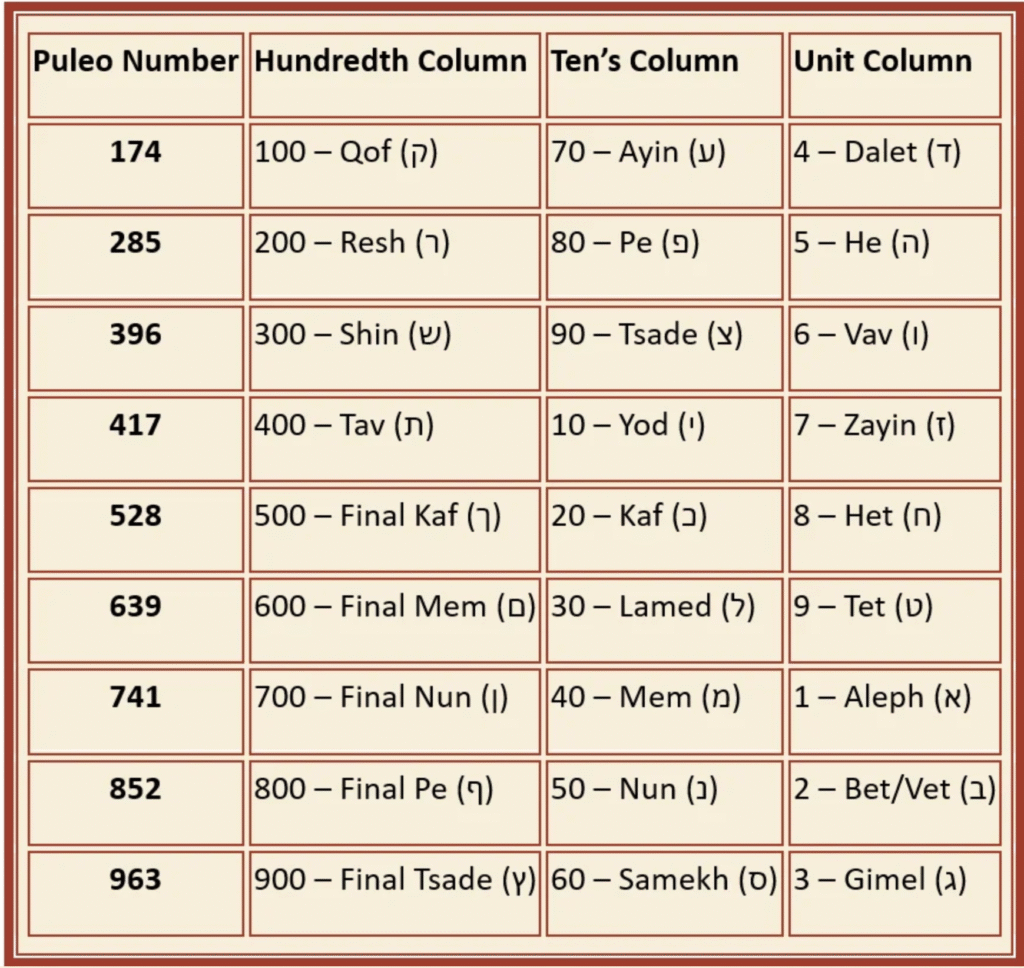
The second clue, Psalm 119, is divided into 22 stanzas of 8 verses each, each labeled with a Hebrew letter. Hebrew is an alphabet that converts numbers to letters. This is called Gematria. Gematria uses ciphers and when I view the Hebrew alphabet, I see two ciphers. The large one where each letter has a unique number, 1-9, 10-90, and 100-900. There is also a small number cipher, that is the numbers without the zeros. This one repeats the numbers 1-9, three times. This is the type of cipher used in Numerology where the numbers 1-9 repeat across the english alphabet, When the nine Puleo Numbers are stacked vertically, each digit from 1–9 appears exactly once in each column. No digits are missing.
Matching the Puleo numbers to the Hebrew Alphabet:
Breaking each number into unit values (e.g., 174 → 100 + 70 + 4) produces 27 distinct values. There are 27 Hebrew letters (22 standard + 5 final forms). This creates a perfect one-to-one match with no leftovers—an extremely unlikely coincidence. From these unit values, each number maps to a three-letter Hebrew root. Each set of three letters can be permuted six ways, allowing searches across the Torah, Biblical Hebrew, and Kabbalistic texts. This process, still being researched, reveals authentic Hebrew roots and meanings, which collectively form a symbolic storyline.
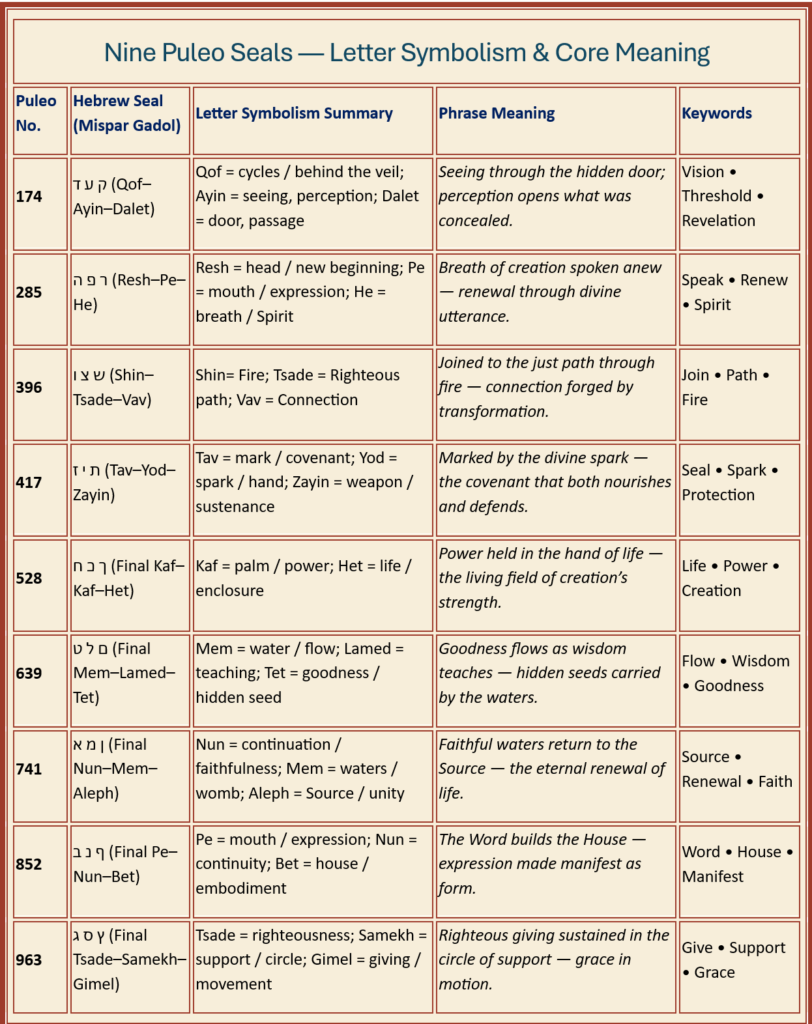
View the Nine Seals and their Tones
The second clue introduces the Hebrew alphabet as a numerical and structural system. While it confirms ordered pattern and completeness, it does not function as a musical key. The letters do not translate directly into sound, nor do they need to. The correspondence of number 22 is noted, but no functional mapping is implied. Meaning can be given to the numbers through Gematria. Using the 9 numbers, their 6 permutations deeper meanings can be found. this is ongoing work that will be revealed over time.
Music: System / Expression
The third clue appears in Psalms 120–134 and is titled The Song of Degrees.
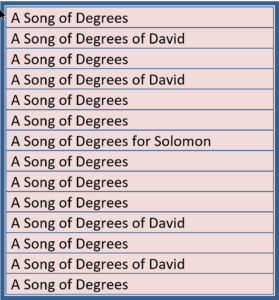
In music, degrees do not describe notes in isolation. They describe ordered steps within a scale. When the phrase “Song of Degrees” is read musically rather than poetically, it points directly to additive structure. This clue is used in three ways. The first is aligning the Phrases with the Puleo Numbers as seen in clue 1 solution. the second shows that the 5 unique phrases point to the Black notes on the Piano with “A Song of Degrees for Solomon” pairing with F#. The Third and final use is describing the 15 note Octave scale , Resolved Just Scale (RJS), embedded in the Scale of 11, a scale found while decoding the clues.
When the Puleo frequencies are plotted across octaves and examined using the Law of the Octave, they resolve into a coherent scale governed by whole numbers and additive intervals of eleven. The frequencies are real, but they do not stand alone. Uncovering the Scale of 11 and then matching it to the Middle C octave gives us the Resolved Just Scale, a 15 note Octave scale.
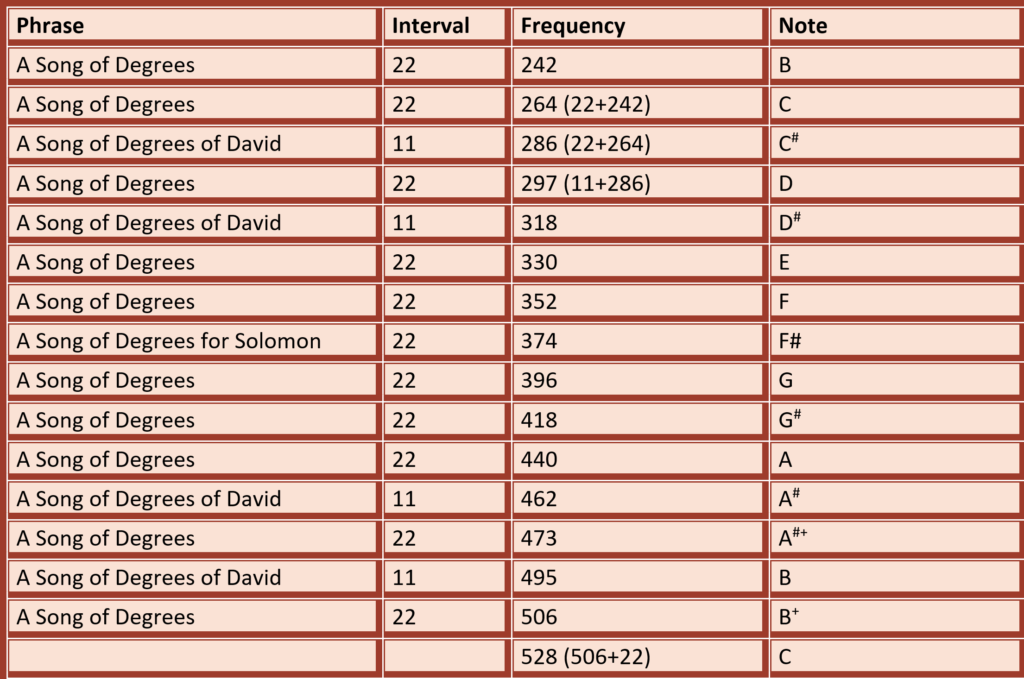
- The Degree Key solution is a 15 note scale within the Scale of 11 which I have named The Resolved Just Scale. The Scale of 11 also contains:
- 1) an Equal Temperament Scale
- 2) A Just Scale
- 3) A quartertone Scale
- 4) the Resolved Just Scale
The Pattern also can slide to another multiple of 11 Number to create a new Musical Key, with new ratios.
The Scale of 11 is the overarching Scale that has the potential to show Mathematical Constants using Musical Ratios in addition to several Scales. What other information can be found by comparing Frequencies, or Ratios or Patterns?
The complete musical derivation is documented on the The Music page, with full tables and analysis in the Deep Dive- Harmonic Decode pages.
Each clue approaches the mystery from a different direction—number, letter, and sound.
Key Insights
- The Puleo Numbers are markers within a larger system.
- The Scale of 11 defines a harmonic structure in which all frequencies and intervals resolve to whole-number multiples of eleven.
- Equal Temperament, Just Intonation, and Quartertone systems all emerge within this structure as subsets of the same field.
- The Resolved Just Scale (15 tones) appears through the application of the Degree Key.
- The Degree Key not only defines new notes—it defines how the system is navigated through movements of 11.
- The structure is revealed through number and sound; meaning is expressed through the Hebrew letter system.
The system can be derived, observed, and verified directly from the numbers.
View The Music Page
Check out the Deep Dive Section