
The Music
The Third Clue: Psalms 120–134
(The Song of Degrees)
This clue reveals the musical structure encoded within the numbers.
The Mystery – 3rd Clue
The following lines are the titles of each of the chapters 120-134 in the Book of Psalms. It is called The Song of Ascent, and I also reference it by calling it the Degree Key.
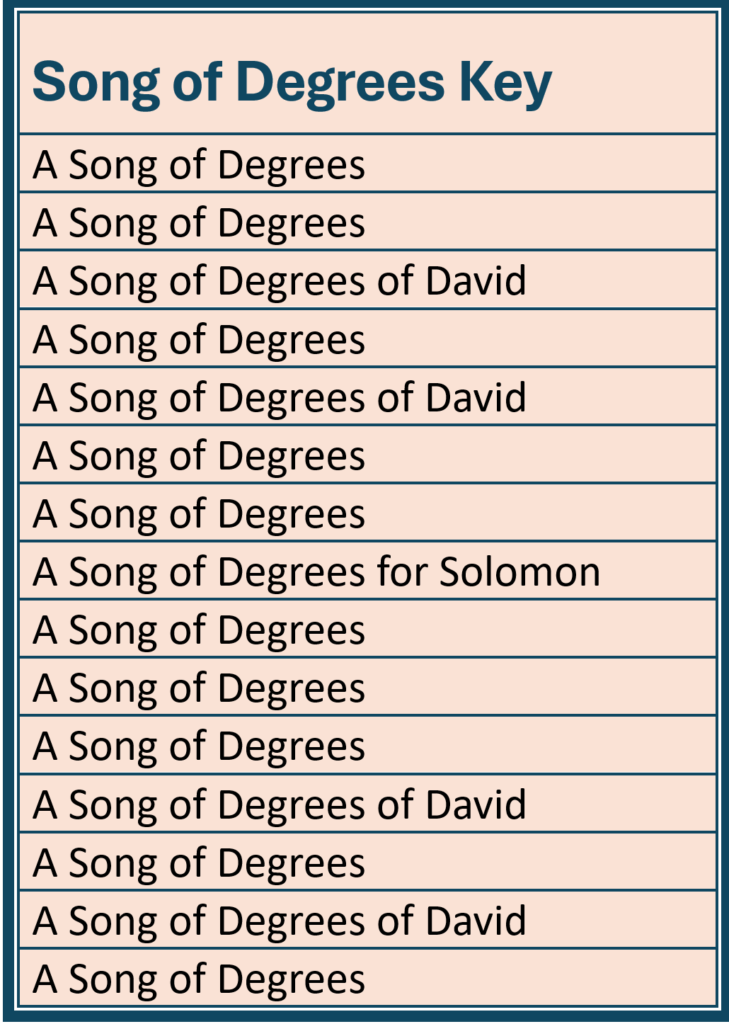
The third clue, The Song of Degrees, points to a musical framework. Song points to sound, while degree refers to a position within a scale, corresponding to an interval. Together, they indicate a structure involving notes, intervals, and scales.
The Degree Key was first used to confirm that only the sets of six and nine numbers are required to solve the mystery. See “The Numbers”.

Solving the Musical Clue
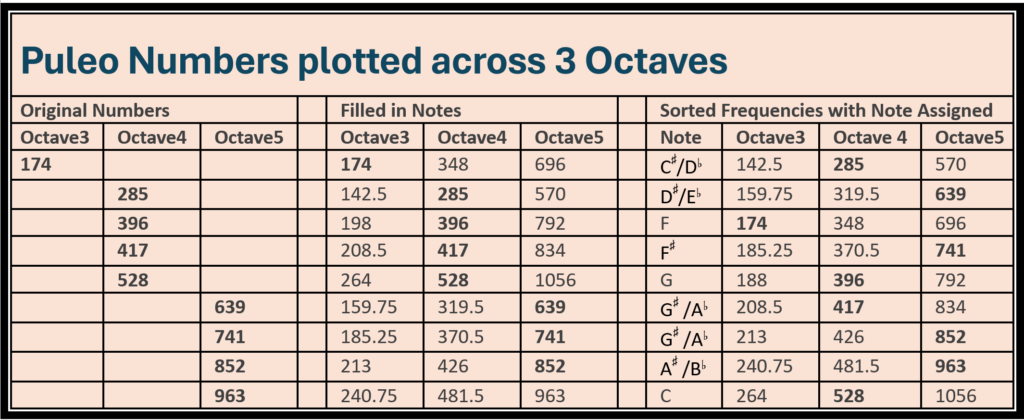
The Puleo numbers span three octaves. When arranged and completed using octave relationships, they form a structured set of frequencies.
I also found a scale in the book “The Power of Limits” by Gyorgy Doczi on page 50. This is the scale in the book. I have named it for this discussion the “Light Scale” because it is on the page that discusses sound, light, and color.

The Light Scale reveals a consistent numerical structure. The intervals between notes are multiples of eleven, and each frequency resolves to a whole-number multiple of eleven.
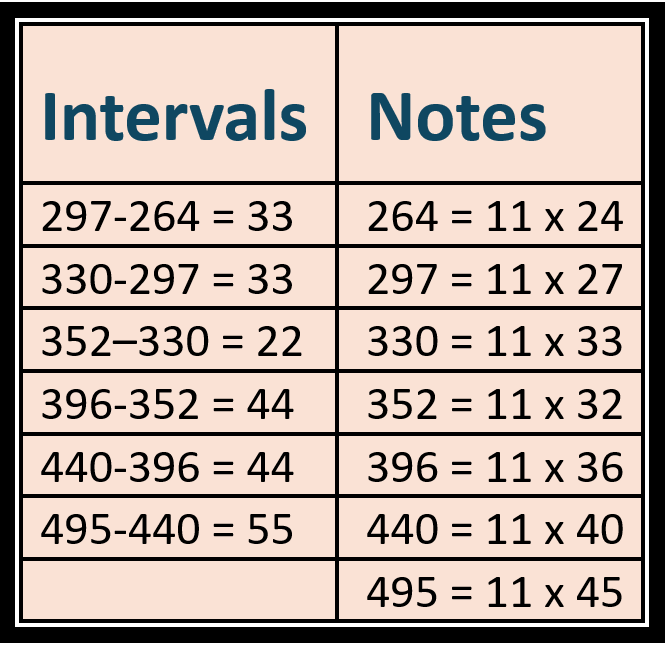
Puleo’s numbers and the scale from the book, the Light Scale.


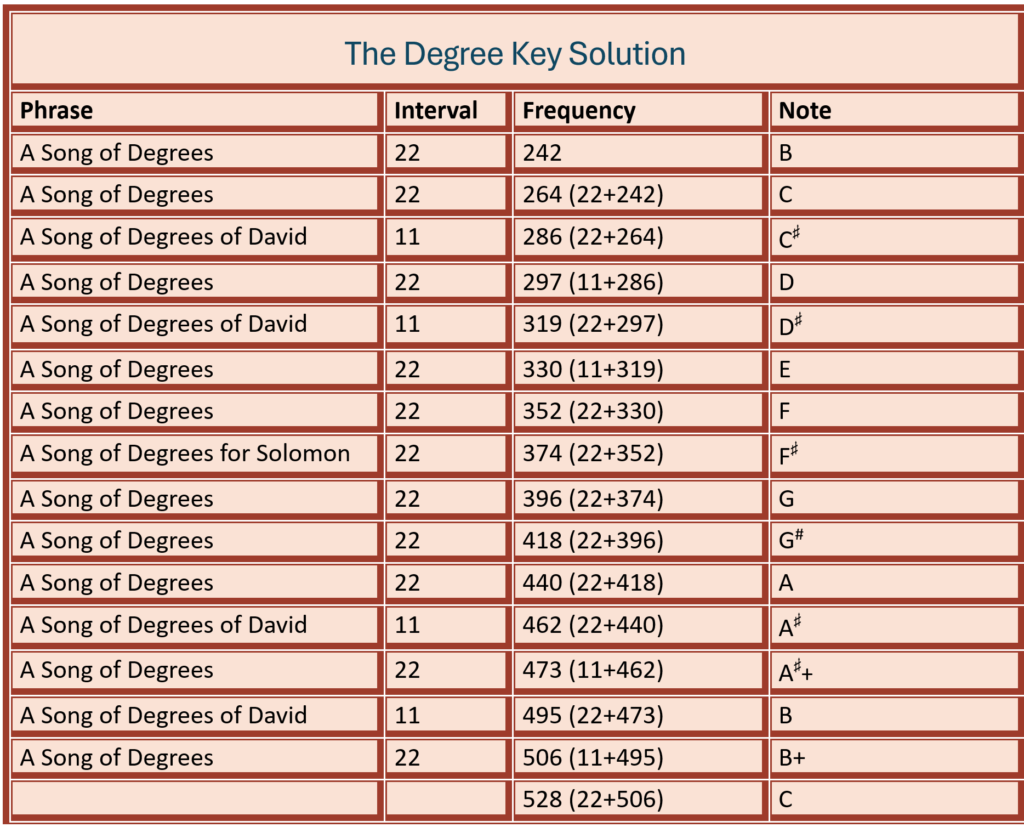
Removing duplicate values reveals five distinct frequencies corresponding to the black notes. The Degree Key contains five unique phrases, which suggest that these phrases are the black notes and “Song of Degrees for Solomon” is F#.
This is the second way that clue 3 is used.

The intervals align closely with multiples of eleven, suggesting a consistent numerical structure based on whole numbers. This is the scale I decided on.

Scale comparison
The Light Scale, Just Intonation, and Equal Temperament align closely in both ratio and frequency. This suggests that these systems emerge from a shared underlying structure.
Equal Temperament vs Light vs Just Intonation vs Adjusted Just Scale
Comparing ratios, decimal values, and frequencies across these scales led to the conclusion that the Light Scale, the Just Scale, and Equal Temperament are closely related.
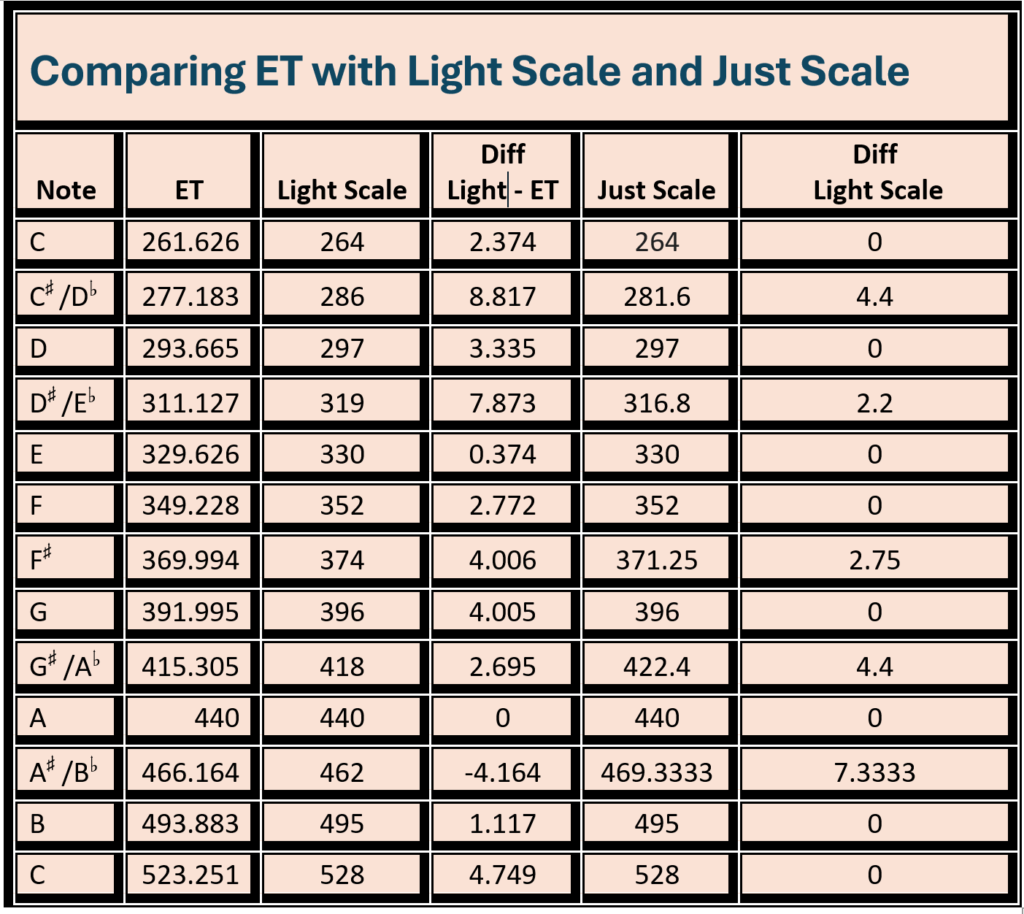
These decimal values as well as the frequencies, are remarkably close, showing that the equal temperament scale is derived from a Just Scale. That Just scale just happens to be close to our Light scale, which I am naming the Scale of Eleven. These values are remarkably close, suggesting that Equal Temperament and Just Intonation emerge from a closely related structure, and the value retained was A=440, because every musical instrument has an A and it is a whole number so very easy to create a tuning fork or other device to generate this tone.
Equal Temperament provides a consistent tuning system, while the Scale of 11 preserves whole-number relationships that produce coherent harmonic patterns.
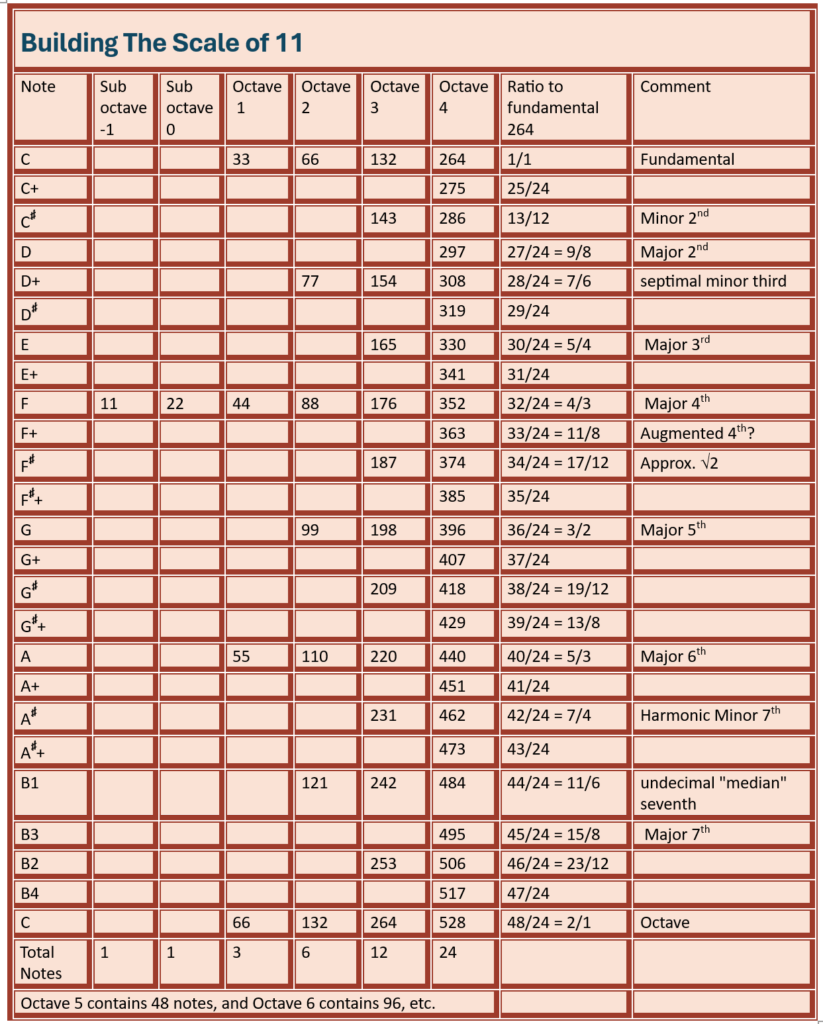
Building the Scale of 11
The Scale of 11 is generated by starting at 11 and adding 11 to each successive value. When extended across octaves, this produces a complete harmonic field. A key observation: the first appearance of a note is always an odd number. All subsequent appearances in higher octaves are even. This makes it easy to spot new notes. I have filled out the first 4 octaves and listed the ratio of the Note to the fundamental. Then added a comment for that Note.
Scales within the Scale of 11
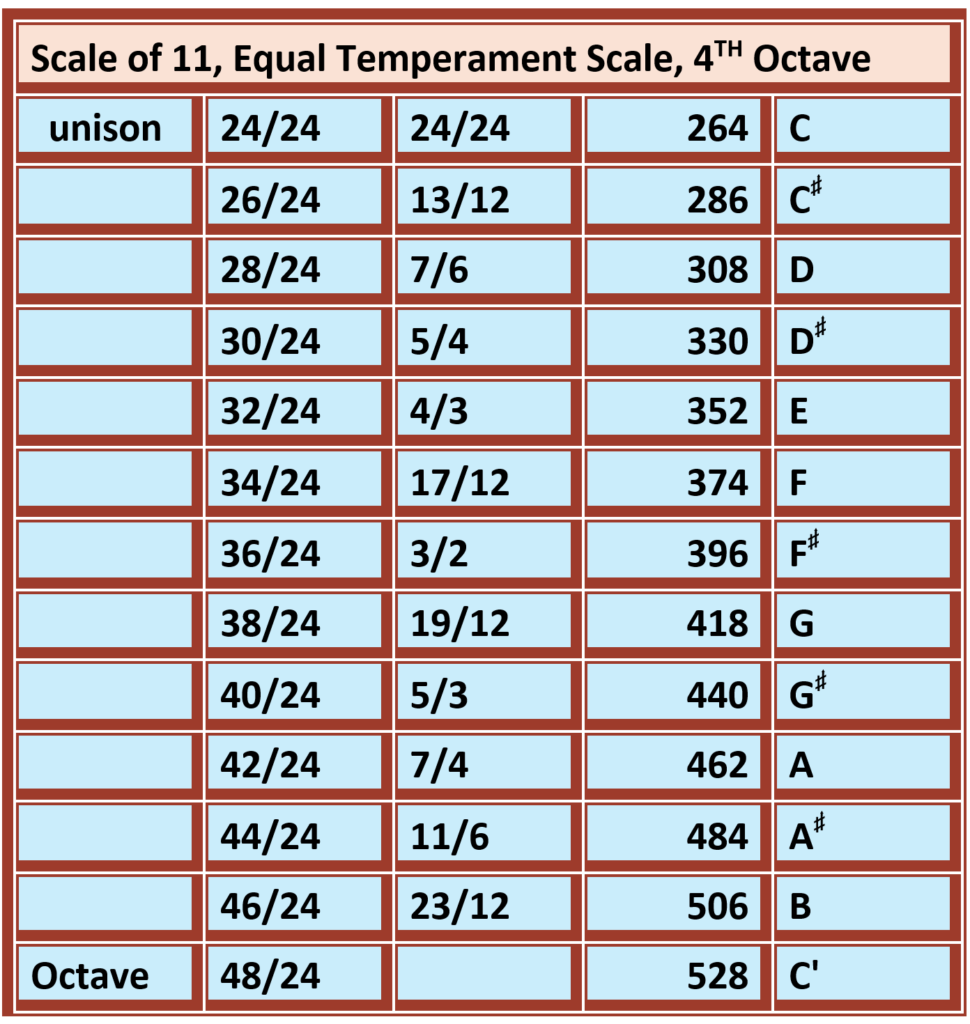
When building the scale of 11, the first thing I noticed was an Equal Temperament Scale in the 3rd Octave with intervals of 11. It is not our Western Equal Temperament (ET) but an Equal Temperament scale, nonetheless. Below is this same scale in the 4th Octave with intervals of 22.
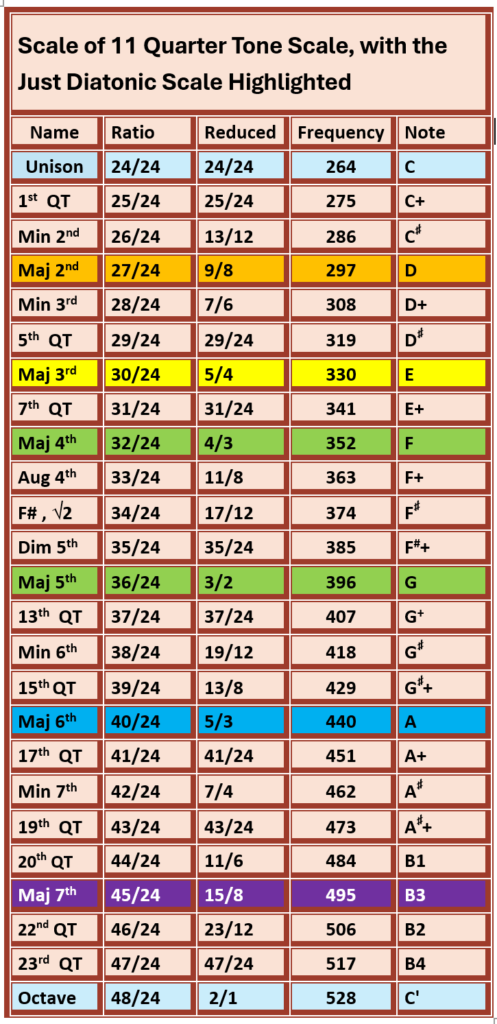
The next chart shows the Quartertone scale of 11 with the Just Diatonic Scale highlighted, showing two more scales within the Scale of 11. (Note: when a QT interval name is also defined, then it is not shown in the first column, only the name of the ratio is shown.) Colored bars denote the diatonic scale, Adjusted Just Intonation scale.
Applying the Degree Key
The Degree Key maps a sequence of intervals within the Scale of 11 using values of 11 and 22. When aligned to the scale, the first phrase lands on a B below middle C. Because the phrases produce familiar musical steps, but do so through numerical addition rather than predefined ratios, the underlying structure was not recognized. Following the numerical pattern, the value of the current note (B–242) is added to the interval (22) to arrive at the next note (C–264).
This produces the familiar C-scale structure. However, without the initial phrase pointing to B below middle C, the presence of two distinct B values would not be apparent. One is 495, which belongs to the Just Scale, and a new value of 506 (or 253 in the 3rd octave). An additional A𝄰 value also appears. With these two new values, the system expands to a 15-note scale.
Finally, we have the new 15 note scale within the Scale of 11. This chart shows the 15 note Octave scale, highlighted in Light Blue. This 15-note scale has been named the Resolved Just Scale (RJS).
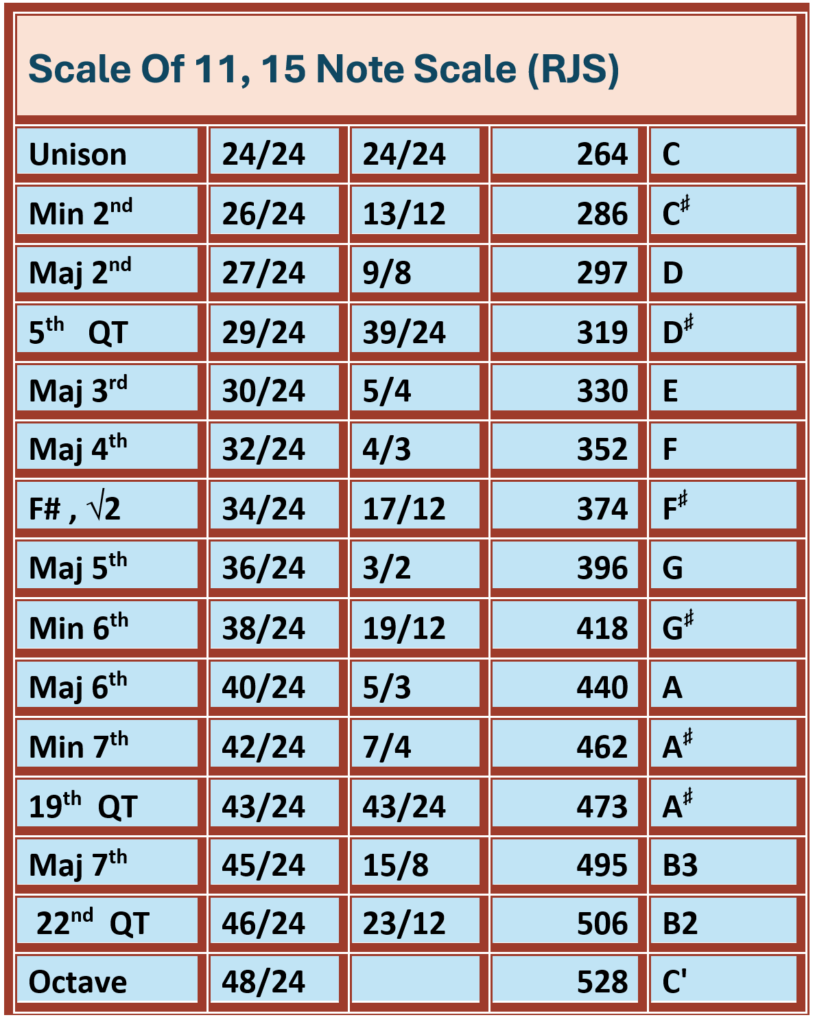
While building the Scale of 11 I found several additional scales within the Scale of 11. An Equal Temperament scale (ET), an Adjusted Just scale (AJI), a Quartertone scale (QT), and the 15-note Resolved Just Scale (RJS). The clue solution also suggests that the Degree pattern can be shifted to create new scales with different tonal centers.
Conclusions
The third clue reveals a structured system of relationships. The numbers attributed to Dr. Puleo are markers—signposts—pointing toward a harmonic structure governed by eleven. When followed precisely, they reveal a system built on whole numbers, consistent intervals, and coherent harmonic relationships.
The Scale of 11 defines the field.
The Degree Key defines how the pattern moves within it.