
Foundational Terms for Puleo Numbers
Mathematical
Digital Compression
Digital Compress is the process of adding the digits of a number together to arrive at a single digit. For Example, take the number 4896. Add 4+8+9+6 = 27, 2+7=9
Digital Root
The Result or answer when adding the digits of a number together. In the exapmle above, 4896 = 9. Nine is the Digital Root.
Pythagorean Math
Pythagorean Math is a structured system using only the digits 1-9 (no zero). These digits are then added or substracted from each other as single digits. there is no carrying over or borrowing from the next unit value.
Gematria / Ciphers
Gematria
Gematria is a system in which letters are assigned numerical values, allowing words and phrases to be expressed as numbers. By summing these values, patterns and relationships can be observed across language, number, and structure.
Cipher
A cipher is a method of encoding information using a defined system of values or rules. In the context of this site, a cipher assigns numerical values to letters, making it possible to translate words into numbers and identify patterns within them.
Hebrew Ciphers Used on this Site.
Mispar Hechrechi (Standard Value) – Each Hebrew letter is assigned its basic numerical value from 1 to 400. Used on this site for interpretive meaning, scripture connections, and booklet notes.
| Letter, Name, Value | Letter, Name, Value | Letter, Name, Value |
| א (Aleph) = 1 | י (Yod) = 10 | ק (Qof)=100 |
| ב (Bet) = 2 | כ/ך (Kaf) = 20 | ר (Resh) = 200 |
| ג (Gimel) = 3 | ל (Lamed) = 30 | ש (Shin)= 300 |
| ד (Dalet) = 4 | מ/ם (Mem) = 40 | ת (Tav) = 400 |
| ה (Heh) = 5 | נ/ן (Nun) = 50 | |
| ו (Vav) = 6 | ס (Samekh) = 60 | |
| ז (Zayin) = 7 | ע (Ayin) = 70 | |
| ח (Chet) = 8 | פ/ף (Pe) = 80 | |
| ט (Tet) = 9 | צ/ץ (Tzadi) = 90 |
Mispar Gadol (Final-Form Expansion) – Same as Standard Value, except final-form letters take expanded values (500–900). Used on this site for the 3-letter Hebrew Seals because it represents the mature or activated form of the number.
| Final Letter | Standard Value | Extended (Gadol) Value |
| ך (Final Kaf) | 20 | 500 |
| ם (Final Mem) | 40 | 600 |
| ן (Final Nun) | 50 | 700 |
| ף (Final Pe) | 80 | 800 |
| ץ (Final Tzadi) | 90 | 900 |
Music
Chromatic Scale
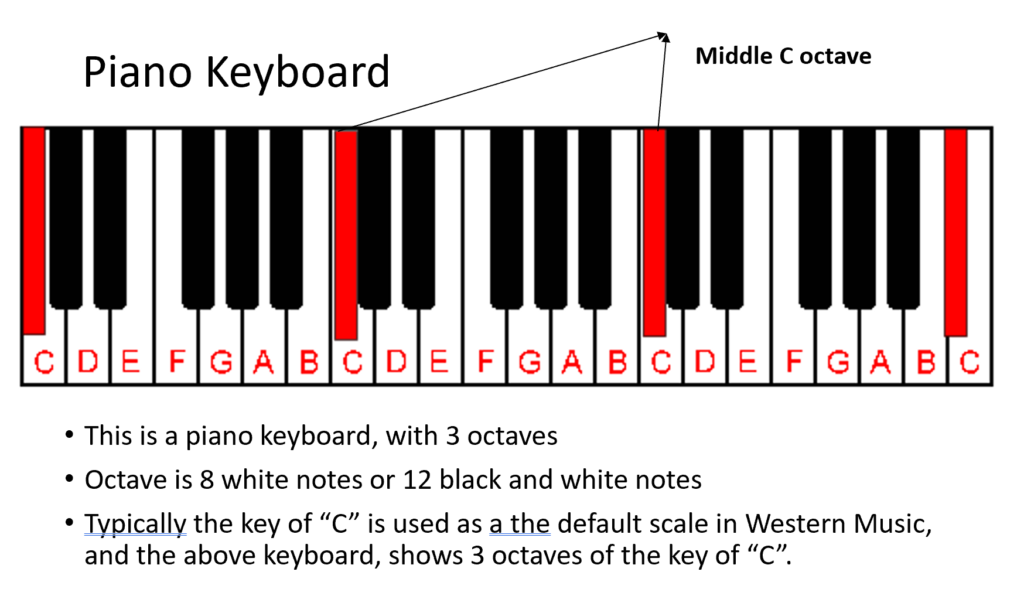
The Chromatic scale is the combination of all the notes in an Octave, both black and white notes.
The twelve notes of the octave—all the black and white keys in one octave on the piano—form the chromatic scale. The tones of the chromatic scale (unlike those of the major or minor scale) are all the same distance apart, one half step. The word chromatic comes from the Greek chroma, color; and the traditional function of the chromatic scale is to color or embellish the tones of the major and minor scales. It does not define a key, but it gives a sense of motion and tension. It has long been used to evoke grief, loss, or sorrow. In the twentieth century it has also become independent of major and minor scales and is used as the basis for entire compositions.
Diatonic Scale
The Diatonic scale is the white notes of an Octave.
Equal Temperament
“An equal temperament is a musical temperament or tuning system that approximates just intervals by dividing an octave (or other interval) into steps such that the ratio of the frequencies of any adjacent pair of notes is the same. This system yields pitch steps perceived as equal in size, due to the logarithmic changes in pitch frequency.” – Wikipedia
“An equal temperament is a musical temperament or tuning system that approximates just intervals by dividing an octave (or other interval) into steps such that the ratio of the frequencies of any adjacent pair of notes is the same. This system yields pitch steps perceived as equal in size, due to the logarithmic changes in pitch frequency.” – Wikipedia
Frequency (Hz)
Frequency is the number of vibrations per second, measured in Hertz (Hz). In this system, frequencies are treated as whole numbers that reveal underlying harmonic relationships.
Interval (in this system)
An interval is the numerical difference between two frequencies. In the Scale of 11, intervals are expressed as whole-number additions, most commonly 11 or 22. It can also be expressed as a ratio or a decimal value.
Just Intonation
In music, just intonation or pure intonation is a tuning system in which the space between notes’ frequencies (called intervals) is a whole number ratio. Intervals spaced in this way are said to be pure, and are called just intervals. Just intervals (and chords created by combining them) consist of tones from a single harmonic series of an implied fundamental.
Law of the Octave
The Law of the Octave states: When you multiply a frequency (in Hz) by 2, you get the same note only an octave higher. When you divide a frequency by 2, you get the same note only an octave lower.
Octave (in this system)
An octave is the doubling of a frequency—the movement from a tone to its double. It can be understood as the “breath” of a note as it expands into the next level.
In this system, an octave is not defined by a fixed number of notes, but by this doubling relationship.
Scale
In music theory, a scale is “any consecutive series of notes that form a progression between one note and its octave”, typically by order of pitch or fundamental frequency.
Solfeggio
From Wikipedia: “In music, solfège (/ˈsɒlfɛʒ/, French: [sɔlfɛʒ]) or solfeggio (/sɒlˈfɛdʒioʊ/; Italian: [solˈfeddʒo]), also called sol-fa, solfa, solfeo, among many names, is a mnemonic used in teaching aural skills, pitch and sight-reading of Western music. Solfège is a form of solmization, though the two terms are sometimes used interchangeably.
Syllables are assigned to the notes of the scale and assist the musician in audiating, or mentally hearing, the pitches of a piece of music, often for the purpose of singing them aloud. Through the Renaissance (and much later in some shapenote publications) various interlocking four-, five- and six-note systems were employed to cover the octave. The tonic sol-fa method popularized the seven syllables commonly used in English-speaking countries: do (spelled doh in tonic sol-fa),[1] re, mi, fa, so(l), la, and ti (or si). There are two current ways of applying solfège: 1) fixed do, where the syllables are always tied to specific pitches (e.g., “do” is always “C-natural”) and 2) movable do, where the syllables are assigned to scale degrees, with “do” always the first degree of the major scale.”
SYSTEM TERMS
Puleo Numbers
The Puleo Numbers are a set of nine frequencies derived from a repeating numerical pattern found in scripture. They are not isolated tones, but markers within a larger harmonic structure that becomes visible when the pattern is followed.
Scale of 11
The Scale of 11 is a numerical frequency system in which every note and every interval is expressed as a whole-number multiple of eleven. As the pattern unfolds across octaves, it reveals a unified harmonic field in which familiar musical systems appear as contained structures.
Harmonic Field
The harmonic field is the complete structure defined by the Scale of 11. It represents the full set of frequencies, intervals, and relationships that emerge from the pattern, within which all derived scales exist.
Additive System
An additive system is one in which movement between notes is determined by adding fixed numerical intervals rather than applying multiplicative ratios. In the Scale of 11, intervals such as 11 and 22 guide the progression from one note to the next.
Degree Key
The Degree Key is a sequence derived from the Song of Degrees that defines movement through the Scale of 11. It operates through additive intervals—primarily 11 and 22—and reveals how notes are connected within the system.
Light Scale
The Light Scale is the Just-based chromatic system that emerges during the early stages of the decode. It reflects whole-number relationships and serves as a precursor to the full expression of the Scale of 11.
Adjusted Just Intonation (AJI)
Adjusted Just Intonation is a modified form of Just Intonation in which frequencies are slightly adjusted to align with whole-number values. These adjustments preserve harmonic relationships while bringing the system into numerical consistency with the Scale of 11.
Resolved Just Scale (RJS)
The Resolved Just Scale (RJS) is a 15-note scale revealed through the application of the Degree Key within the Scale of 11. It expands beyond the traditional 12-tone system by introducing additional notes that arise naturally from the pattern.
Quartertone Scale (QT)
Within the Scale of 11, the Quartertone Scale divides the octave into 24 steps using increments of 11. This reveals intermediate tonal positions and demonstrates how finer divisions of pitch exist within the larger structure.
Emergent Structure
An emergent structure is one that reveals itself through the observation of patterns. In this work, the system is not imposed or constructed in advance—it becomes visible as the numerical relationships are followed.