
Part 1 of 5
The Third Clue: Psalms 120–134 (The Song of Degrees)
This document presents a direct decoding of the third clue—The Song of Degrees—through number, interval, and musical structure.
The Third Clue: Revealing the Structure Behind the Numbers
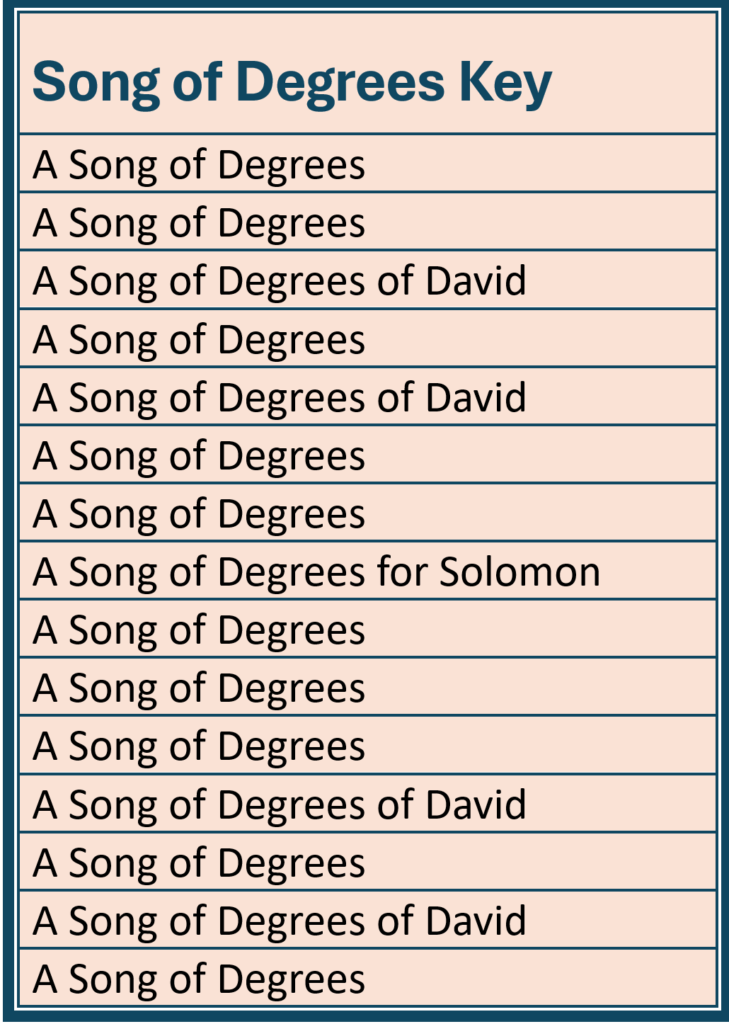
The numerical clues into a complete harmonic system. The following lines are the titles of Psalms 120–134 in the Book of Psalms. This group is traditionally called The Song of Ascents. For the purposes of this work, I refer to it as the Degree Key.
The third clue—The Song of Degrees—was the most elusive of the three. The repeated use of the words Song and Degree suggests a musical framework. In music, a degree refers to a position within a scale, which corresponds directly to an interval. Both terms point toward structure—intervals, scale positions, and note relationships.
This is not presented as a theory, but as a step-by-step reconstruction derived directly from the numbers. Each stage builds on the last, and each conclusion arises from the structure itself.
The third clue—The Song of Degrees—was the most elusive of the three. The repeated use of the words Song and Degree suggests a musical framework. In music, a degree refers to a position within a scale, which corresponds directly to an interval. Both terms point toward structure—intervals, scale positions, and note relationships.
The first use of the Degree Key appeared earlier, where it revealed that only the sets of 6 and 9 numbers were required to begin solving the system (see The Numbers.)
Musical Rules
So far, the numbers have been examined on their own. The next step is to place them into a musical setting and see how they behave.
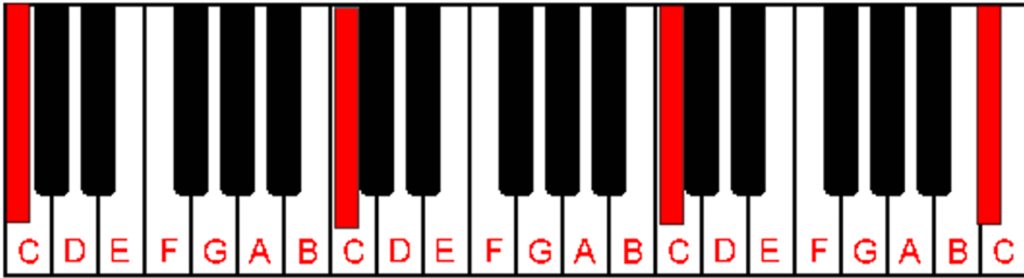
[DIAGRAM: Three Octaves on Keyboard (C–C–C–C)]
- Each octave repeats the same sequence of notes. The only difference is the frequency.
- An octave contains 8 white notes and 5 black notes. The white notes, in order, are C–D–E–F–G–A–B–C. In the diagram above, three octaves are shown, with C highlighted to mark the beginning of each octave.
- Frequencies increase in strict numerical order across the keyboard—they do not rearrange or skip position.
- Black notes have two names: a sharp (half-step up) and a flat (half-step down) relative to adjacent white notes.
- The Law of the Octave:
Doubling a frequency produces the same note one octave higher- 264 → 528 → 1056
- (C) (C) (C)
- Halving a frequency produces the same note one octave lower
- Cycles per second (cps) is the earlier term for Hertz (Hz).
- Frequencies within approximately 2 Hz are generally indistinguishable to the human ear.
- The piano contains 88 keys spanning 7 octaves.
- All ratios within a single octave fall between 1.0 and 2.0
Constructing the Initial Scale
When I first read Puleo’s account, I also assumed the numbers might represent frequencies. Plotting the nine numbers revealed that they span three octaves. Using the Law of the Octave, I filled in the missing octave values. However, once extended, the numbers within each column were no longer in numerical order, so I reorganized them. The original Puleo numbers are shown in bold for reference.
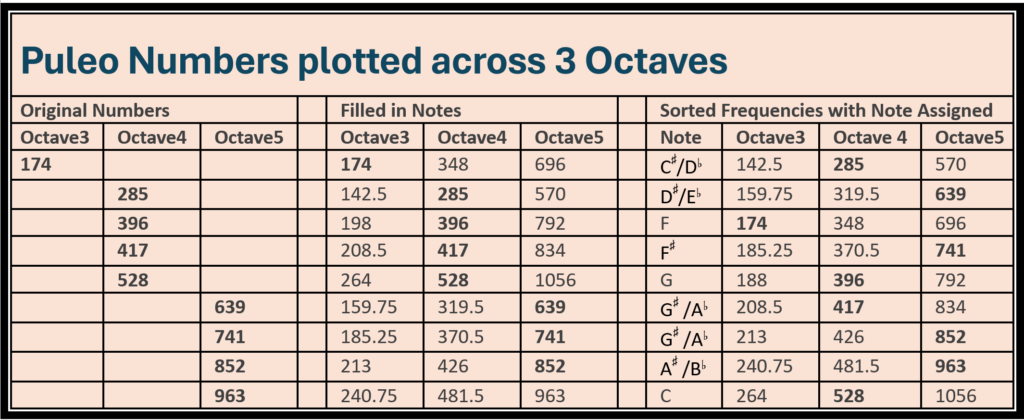
At this stage, the goal is not to interpret the numbers, but simply to organize them in a way that allows patterns to become visible.
I also found a scale in The Power of Limits by György Doczi (page 50). I had previously written beside it: “What scale is this?” For this discussion, I refer to it as the Light Scale, as it appears in a section relating sound, light, and color.

Seeing 396 and 528 appear in both systems raised an important question: were these numbers pointing to the same structure from different directions? At first glance, this is not obvious. To arrive at this scale, one would typically need knowledge of Just Intonation. However, the frequencies 396 and 528 can generate a Just Intonation (JI) scale. Both the diatonic and chromatic structures emerge. This was the first point where two independent sources—the Puleo numbers and the Light Scale—appeared to overlap. That overlap suggested they might be describing the same underlying structure from different directions.
I then examined the intervals by subtracting adjacent values: Every interval is a multiple of eleven, and each note value is divisible by 11.
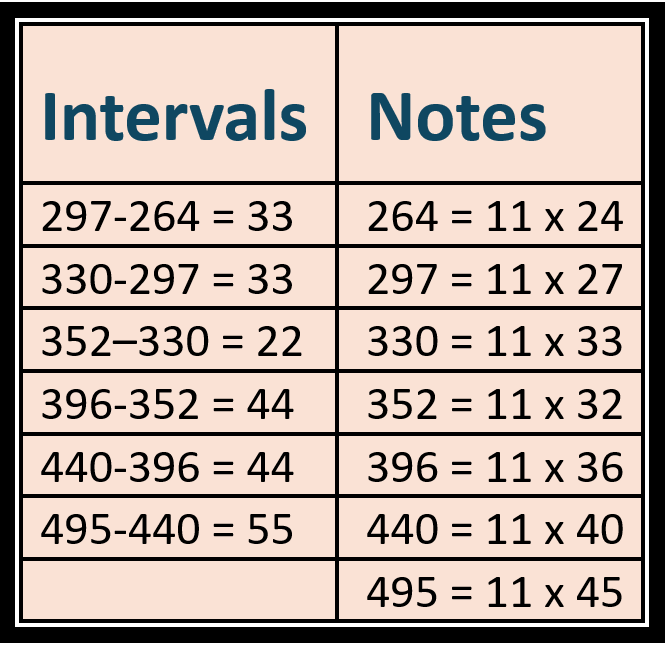
This was the first clear indication of a consistent underlying pattern:
This was the first clear indication of a consistent underlying pattern:
The note values resolve to multiples of 11
The intervals resolve to multiples of 11
This repetition is not incidental. When both the values and the distances between them resolve to the same base number, it indicates the presence of an organizing principle rather than coincidence. a coherent system begins to emerge.
Looking at the numbers this way makes the pattern easier to see. Both the notes and the distances between them follow the same numerical base. When a pattern repeats at both levels—the note values and the spacing between them—it indicates an underlying structure rather than coincidence.
At this stage, duplicate note values appear—specifically two versions of F and two versions of G♯/A♭.
This raises a critical question: which values belong in the final structure?
At this point, more than one value appears for certain notes, so a selection has to be made. This creates a choice: which values belong in the final structure? To answer that, a simple rule is applied. The correct values are the ones that preserve the pattern that has already started to appear—whole-number multiples of eleven and consistent spacing between notes.
Resolving F
For F, two possibilities appear:
352 (from the Light Scale)
174 / 348 / 696 (from the Puleo set)
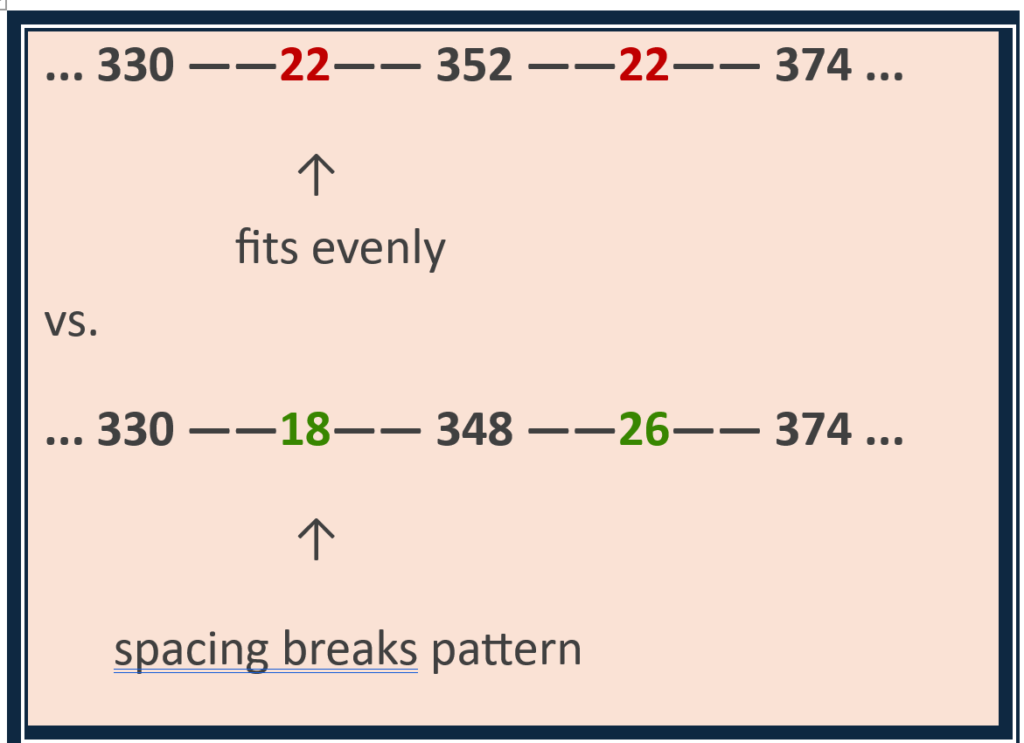
The value 352 fits cleanly into the developing pattern. It aligns with the other notes as a whole-number multiple of eleven and maintains consistent spacing. For that reason, 352 is carried forward.
Resolving G♯/A♭
For G♯/A♭, two candidates emerge: 417 and 426/ 852. 417 sits naturally between 396 (G) and 440 (A), keeping the spacing between notes even. This makes it consistent with the structure that is forming, so it is selected.
Result
The resulting set of frequencies (middle C octave) is:

639/2 = 319.5; 741/2 = 370.5; 852/2 = 426/852 (discarded); 963/2 = 481.5.
Another Perspective
Here is a separate way of looking at the two sets of numbers. Puleo’s numbers and the scale from the book, the Light Scale.


After removing the shared values (396 and 528), the remaining values were compared. The F value (174/348 across octaves) was removed because it did not preserve the multiple-of-11 pattern. The higher G♯/A♭ value (852/426) was also removed, as 417 more accurately preserves the spacing between G and A.

Just the Black Notes remain.
Key Insight
When duplicate values are removed:
The remaining values correspond to the black notes
Exactly five notes remain
This becomes significant when compared to the Degree Key, which contains five distinct phrase variations.
This is the second functional use of the third clue.
A scale has now been identified—but how does it hold up within a tuning system?
I looked at the intervals again.

The bold numbers are diatonic or white notes.
Continue to Part 2