
Part 2 of 5
Part 2 – Numbers to Structure
Organizing the values to reveal a consistent system
A System of Markers
Something different begins to emerge. The Puleo numbers don’t behave like a conventional musical scale. Instead of forming a complete set of notes, they appear at specific points within a larger structure. A helpful way to think of them is as reference points. They highlight where important relationships exist, rather than defining all of the relationships themselves.
This becomes clearer when looking at the intervals. They come very close to multiples of eleven, but not exactly—indicating the structure is being approximated rather than fully expressed.
To bring the structure into focus, the values can be adjusted slightly into alignment while remaining within perceptual tolerance. as a structural change. Both the notes and the intervals settle into consistent multiples of eleven.

Intervals show the distance between notes. The size of the step changes, but each step is still an interval. Although this process is purely numerical, it produces the same sequence of note relationships found in a musical scale.

The bold numbers indicate the frequencies that were adjusted.
Three candidates emerged for A𝄰 /B𝄬: 462, 473, and 484.
462 was selected because:
It preserves the 22/33 interval structure
It aligns cleanly with the ratio 7/4.
This produced a fully consistent system.

Just Intonation (JI)
I then looked at different tuning systems, particularly Just Intonation.. I found a site by Kyle Gann, a composer and author of several books on American music and microtonality, that clearly explained Just Intonation, as well as many other pieces of information on music theory. I also found a page called the anatomy of an octave. This table gives ratios and decimal values for a host of numbers.
This chart shows the ratios of a Just Intonation scale. This table will be our reference table for interval names and ratios and the Note Name.
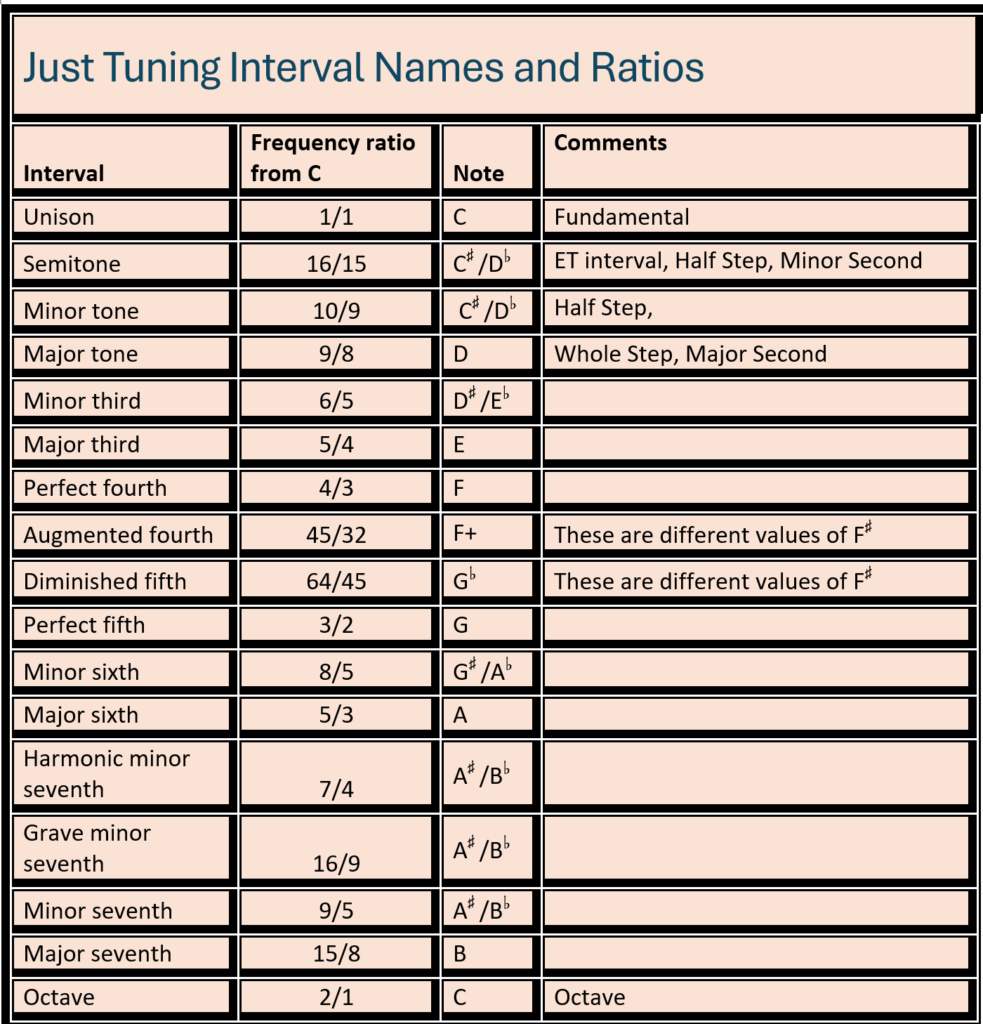
Semitone refers to the interval of the Equal Temperament Scale. Augmented fourth and diminished fifth are values for F𝄰 and there are several values for the 7th. The Harmonic minor Seventh’s companion is 8/7. It is not a ratio within today’s music because most modern Western music is typically limited to factors no larger than the prime number 5. The ratios of 8/7 and 7/4 are ratios in the Lamdoma scale (discussed later) where the limit for factors is the prime number 7.
A key property of Just Intonation is symmetry through reciprocal ratios.
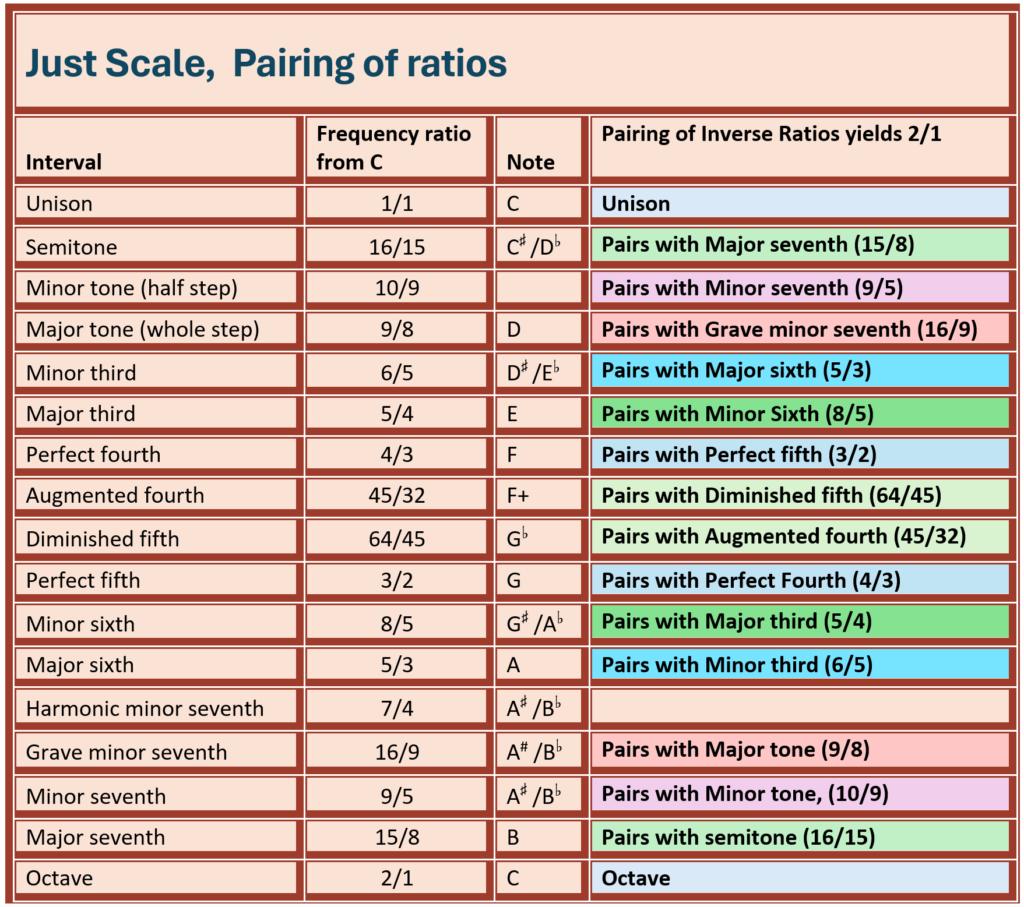
- The Perfect Fourth (4/3) pairs with the Perfect Fifth (3/2):
- 4/3 x 3/2 = 2.
- Four (fourth) + Five (fifth) = 9.
- The Minor Third (6/5) pairs with the Major Sixth (5/3):
- 6/5 x 5/3 = 2.
- Three (third) + Six (sixth) = 9.
- The Major Third (5/4) pairs with the Minor Sixth (8/5):
- 5/4 x 8/5 = 2.
- Three (third) + Six (sixth) = 9.
The ratios multiply to 2, while the interval numbers sum to 9.
We now take the Just Intonation reference table and add the Frequencies and decimal equivalent for the ratios for each note base on C=264 Hz. C=264 was chosen because that is the value of C in the Light Scale.
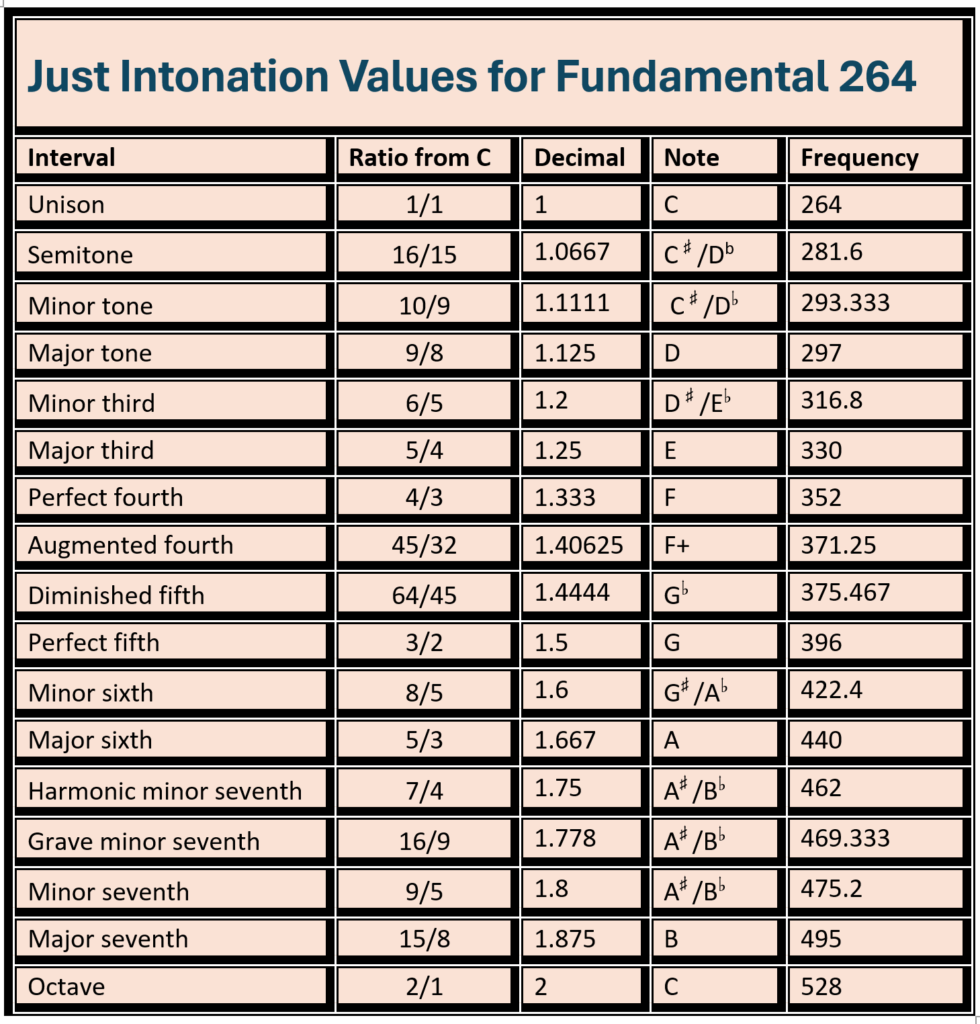
F𝄰 is not listed in this table. The JI ratio is 45/32 with a frequency of 371.25.
Alternative Just Scale
Now I wanted to know how well the Light Scale compares to the Just Intonation Scale. When I tried to construct a Just scale using 264 as the fundamental, I ran into a key limitation.
- The final frequency needed to be a whole number, because I wanted to keep the pattern of whole numbers with factors of 11 and intervals that were multiples of 11.
- I wanted to see if there were alternative ratios for a Just Scale.
- The ratios needed to remain small, and the denominators had to be limited to factors of 2, 3, 4, 6, 8, and 11—because 264 is only divisible by these numbers.
- Ratios containing factors of 5, 7, or 9 in the denominator could not produce whole-number frequencies.
- Each of the black note ratios in the reference table had denominators containing factors of 5 or 9. Therefore, I needed to find new fractions within the same range that preserved whole numbers and multiples of 11.
Using the Anatomy of an Octave, I was able to find ratios that matched these criteria.
This became the Light Scale chromatic system—a structure where frequency, interval, and number align simultaneously.
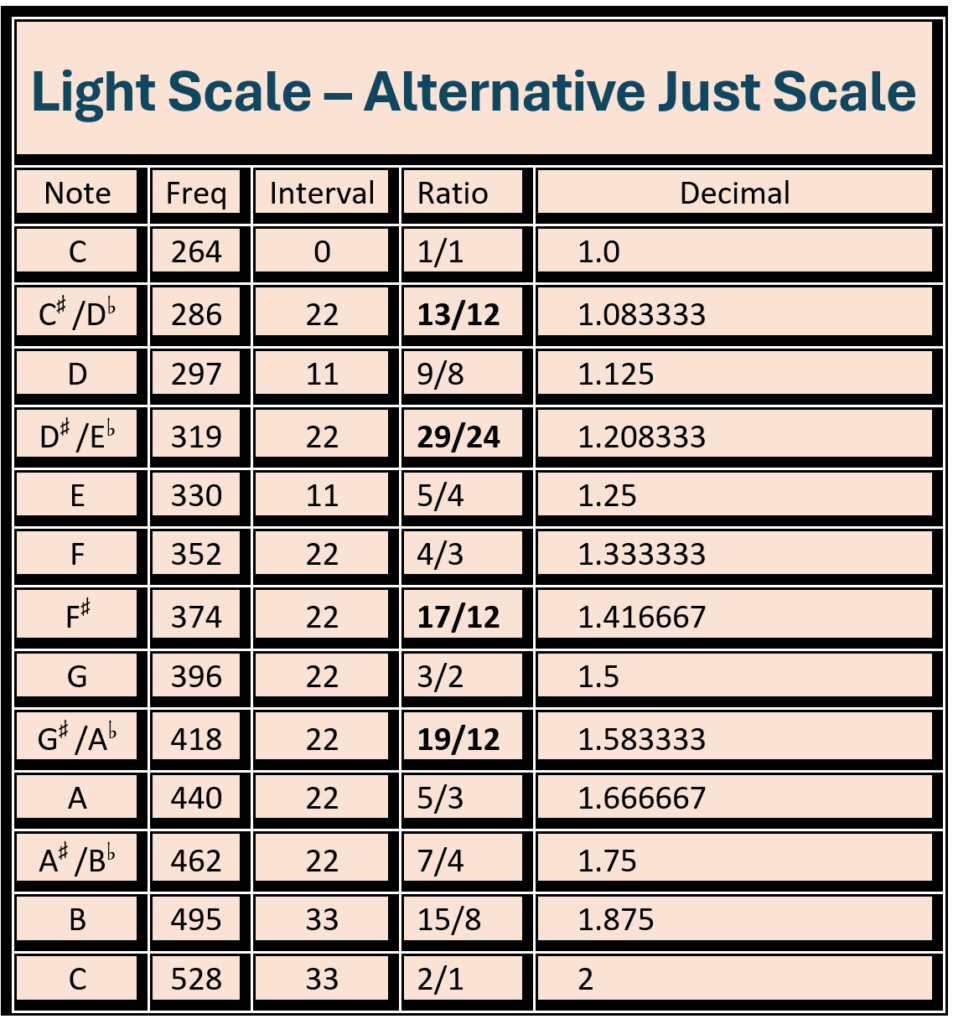
Notice that A𝄰/B𝄬 became 7/4, with new ratios for the other black notes (bolded).
These ratios are alternative ratios for a Just Intonation scale.
At this point, the system moves beyond the traditional Just Intonation ratios while still remaining within a Just framework. The priority becomes preserving whole-number relationships and the eleven-based structure.
Notice that the white notes match the Just tuning for the diatonic scale. It seems like every way we look at the black notes we have a lot of flexibility with the intervals and with the ratios. At this point, reciprocal pairing of ratios is no longer preserved. The consistency of whole numbers and intervals of eleven was too precise to ignore, so I retained the pattern and allowed the ratios to adjust accordingly. This raises an important question: what system are these numbers marking? So, I next looked at the equal temperament tuning we have today for the middle C octave.
This raises an important question:
If these numbers are markers, what system are they marking?
This leads directly to the system we use today. If this structure is valid, it should also be visible within modern tuning. The next step is to examine how the Light Scale and the Adjusted Just Scale align with Equal Temperament and the standard A=440 reference.