
Part 3 of 5
Harmonic Decode Part 3
Three Systems
Equal Temperament
In Part 2, the numbers revealed a consistent structure—one grounded in whole-number relationships and intervals of eleven.
As the structure unfolded, the tuning systems we recognize today began to appear within it. To test this, we compare three systems: Equal Temperament, traditional Just Intonation, and the Light Scale. By examining their frequencies, ratios, and decimal values, we can determine whether consistent relationships exist—and whether these systems are, in fact, different expressions of the same underlying harmonic framework.
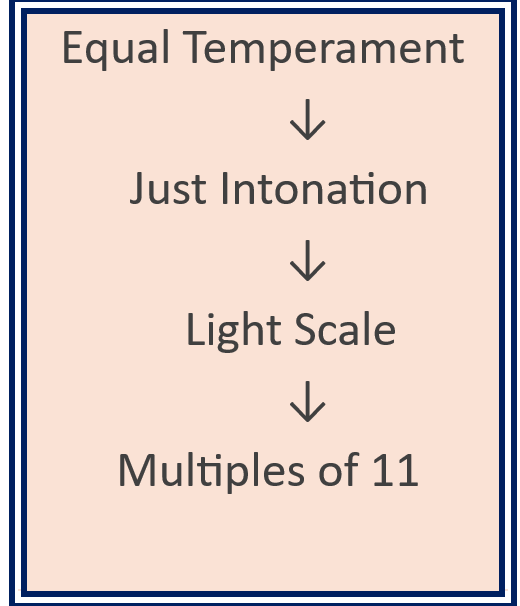
“An equal temperament is a musical temperament or tuning system that approximates just intervals by dividing an octave (or other interval) into steps such that the ratio of the frequencies of any adjacent pair of notes is the same. This system yields pitch steps perceived as equal in size, due to the logarithmic changes in pitch frequency.” – Wikipedia
The following table compares the equal temperament scale (ET) frequencies with The Traditional Just Intonation (JI) frequencies with a fundamental of 264. The use of comparing frequencies instead of ratios is because ratios in equal temperament are not whole numbers and therefore do not carry the same harmonic significance in this context.
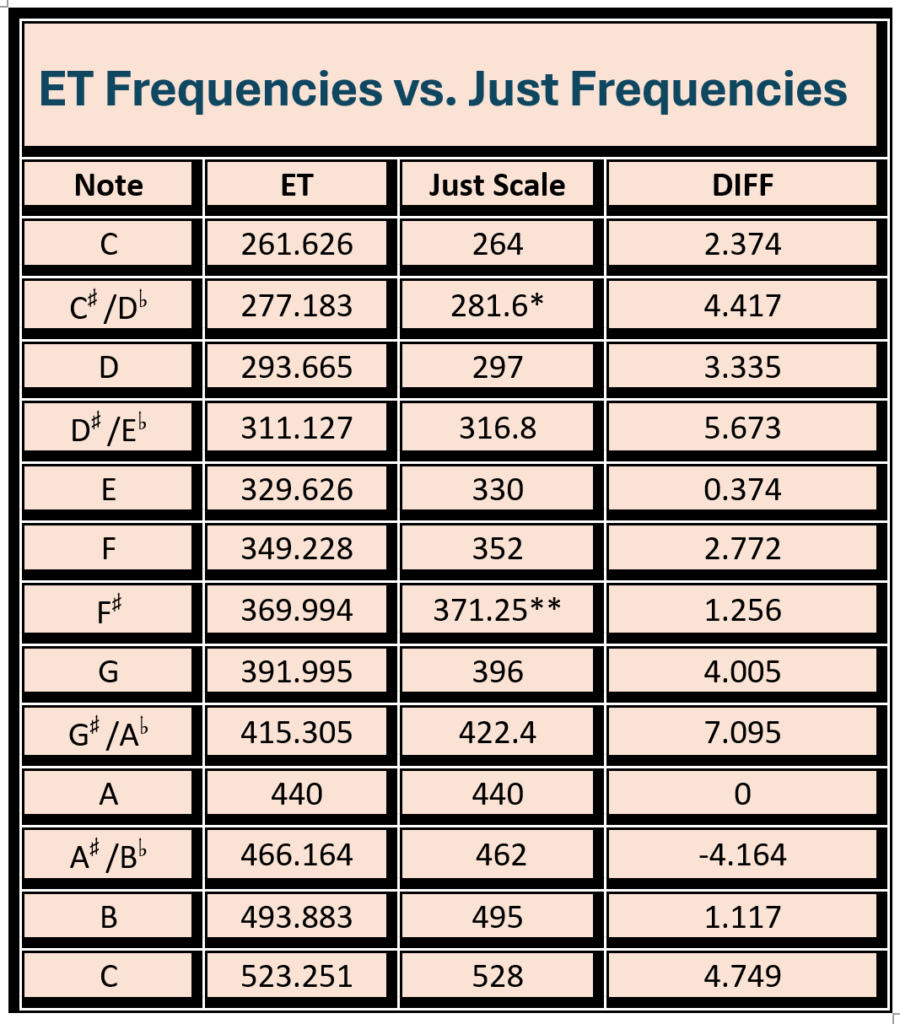
*281.6 was chosen because it is the ET semitone
** No F# value is listed in the Just Intonation ratios/ Intervals, instead we have augmented 4th (371.25) and diminished 5ths.
Now we will compare the Equal Temperament scale frequencies with the Chromatic Light Scale frequencies and calculate the difference. This shows just how close the Light Scale frequencies are to our traditional music scale of today.
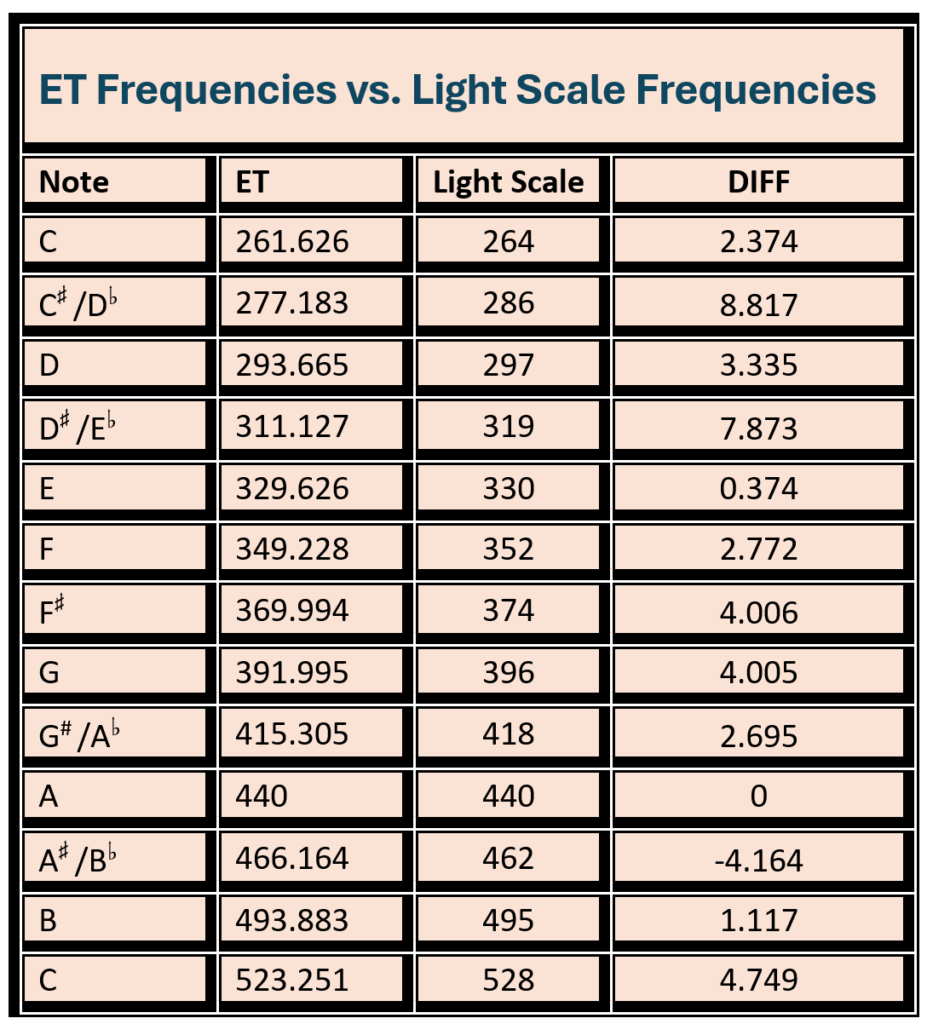
These are close, but some of them are more than 2 Hz difference, which is noticeable. Since equal temperament frequencies are generated mathematically from the 12th root of 2, they are not pure tones, but we have become accustomed to these sounds.
Just Intonation vs. Equal Temperament
The following table compares Equal Temperament Decimal intervals and frequency values to Just Intonation decimal intervals and frequency.
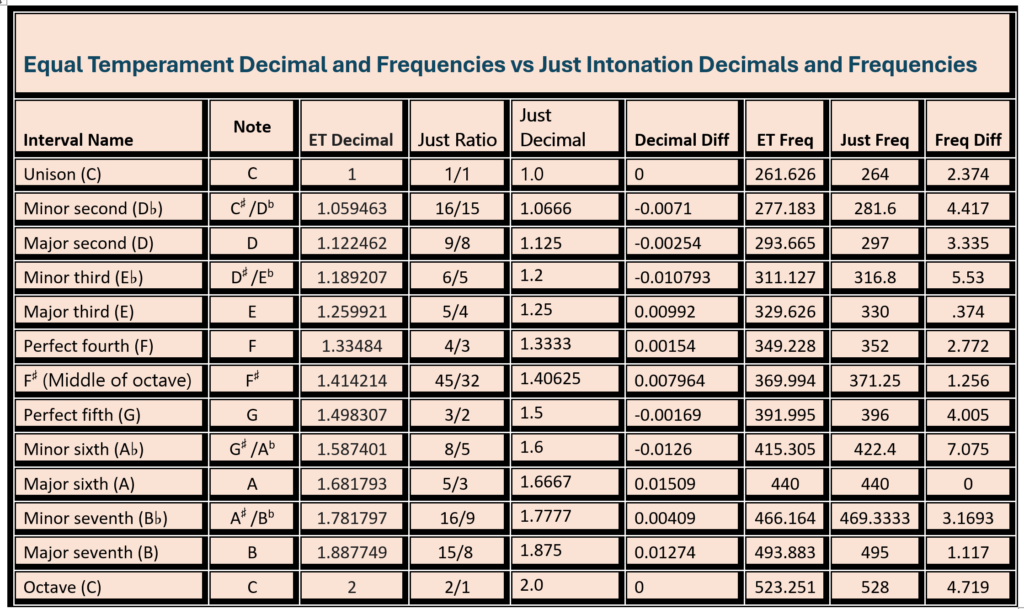
Notice the decimal relations are extremely close but the actual value of the frequencies can be from 0 to 7 Hertz .It only takes a small decimal change to increase the frequency. The fact that the decimal values are close between the ET scale and the JI scale strongly suggests that the Equal Temperament scale is derived from a Just-based framework.
Just Intonation Vs. Light Scale
Now we look at the reference Just Intonation table frequencies and the Light Scale frequencies.
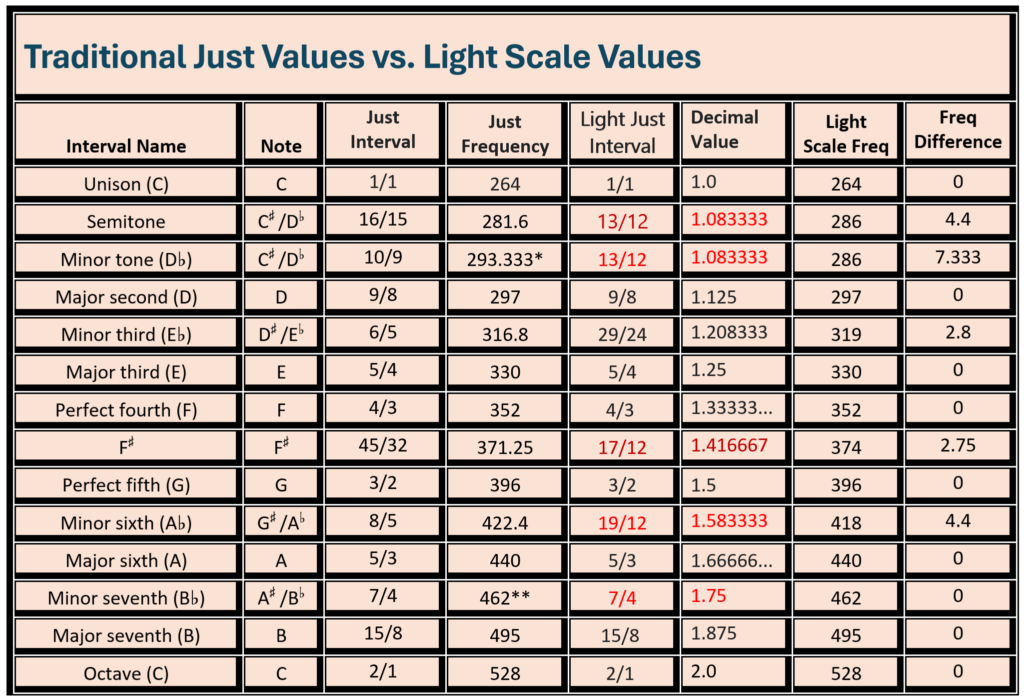
*293.333 is listed here as an alternative half-step value in the Just Scale.
** 462, the Grave Minor 7th was chosen because its ratio is the same ratio in the Light Scale.
When using the new ratios that match the Light Scale, we get an Adjusted Just Scale. Again, the only values that change are the black notes; the diatonic scale, or white notes, have not changed. It appears that the Equal Temperament scale, the Light Scale, and the Just scale are all intertwined.
Comparing all Three Systems
We now look at all 3 scales by Frequency.
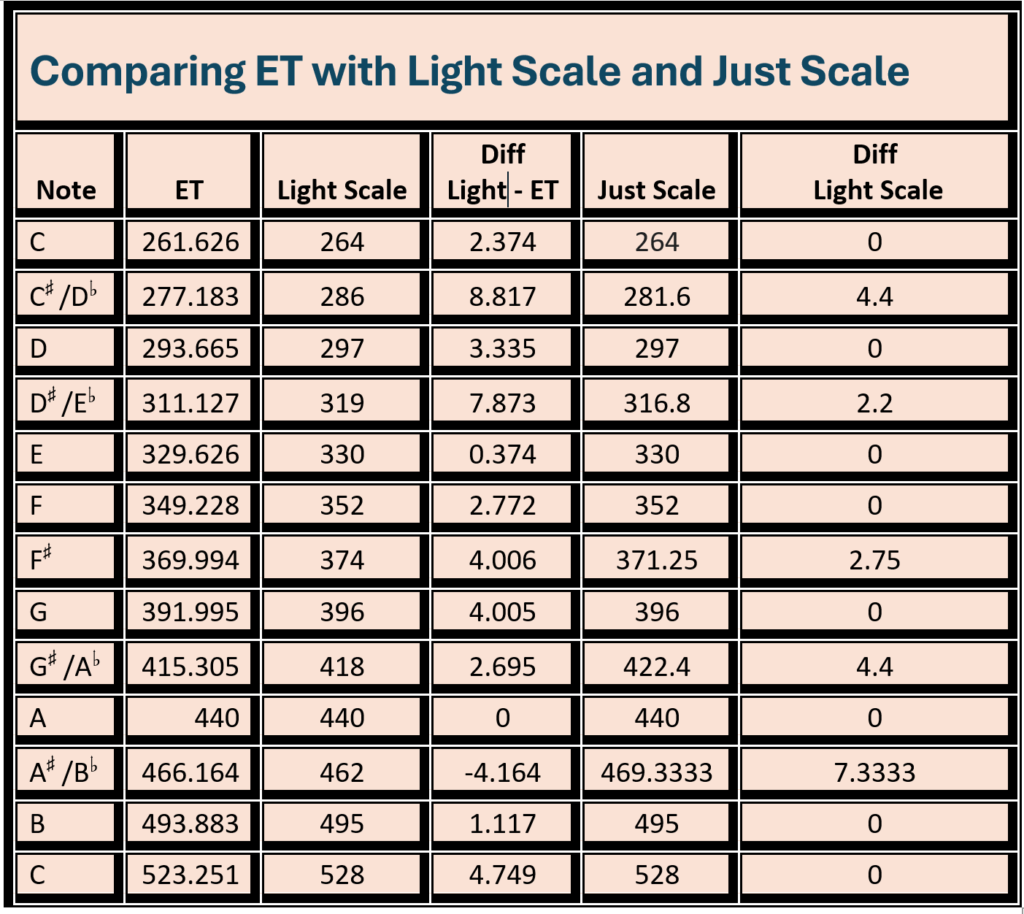
Across all three systems, the relationships are remarkably consistent. Equal Temperament approximates Just Intonation, Just Intonation aligns closely with the Light Scale, and the Light Scale resolves cleanly into whole-number relationships and multiples of eleven. This suggests that Equal Temperament is not arbitrary—it is an approximation of an underlying harmonic structure rooted in whole-number ratios. While Equal Temperament allows music to be transposed into different pitch centers and enables multiple instruments to play together within a consistent tuning system, it comes at the cost of exact harmonic alignment.
The exact frequencies found in Just Intonation and the Light Scale are not preserved in Equal Temperament—they are altered to fit the system. Natural harmonics arise from whole-number ratios, and when those ratios are adjusted, the resulting frequencies change, along with the coherence of the harmonic relationships.
The frequencies that were lost—the ones Dr. Puleo was seeking—occurred when music shifted to Equal Temperament.