
Part 4 of 5
Harmonic Decode Part 4
The Scale of 11
A Scale Defined by Eleven
In Part 3, the relationships between Equal Temperament, Just Intonation, and the Light Scale revealed a consistent underlying structure. The next step is to follow the structure as it unfolds, beginning from its simplest form.
Beginning with the number 11, the pattern expands across octaves, revealing a scale in which every frequency and every interval resolves to a whole-number multiple of eleven.
The following table shows the build out of the Scale of 11 for the first 6 octaves. The first two octaves fall below the range of a piano. Each column represents an octave. The scale starts with 11, the Note F, and moves up the keyboard in increments of 11. The first note on the piano in this scale is C=33. You can then multiply 33 by 2 for the next octave, and repeat for other octaves: 66, 132, and 264 in octave 4, the middle C octave. As each new note appears, you can create the subsequent octaves by multiplying by 2. For example, 77 becomes 154 and 308. Then 99 becomes 198 and 396, etc.
A key observation: the first appearance of a note is always an odd number. All subsequent appearances in higher octaves are even. This makes it easy to identify new notes. I have filled out the first 4 octaves on the piano and listed the ratio of the Note to the fundamental. Then added a comment for that Note. The Light Scale is now expressed as the Scale of 11, and the names can be used interchangeably.
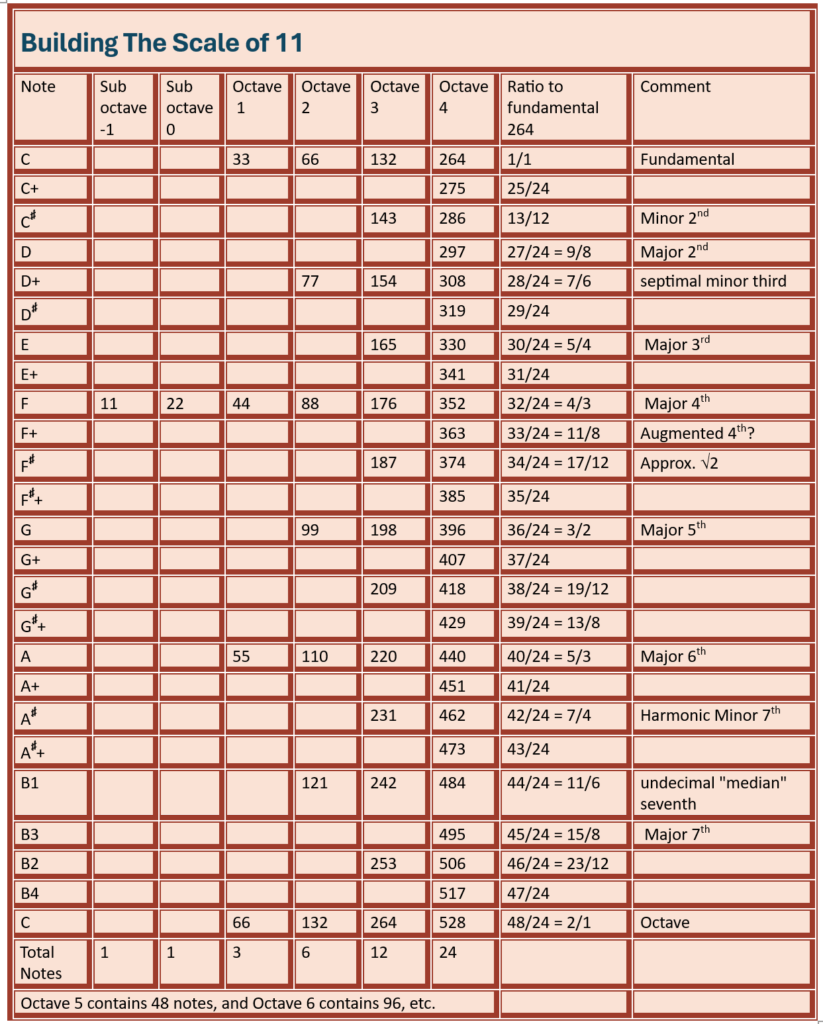
The defining property of this system is this:
Every frequency and every interval resolves to a whole-number multiple of eleven.
Scales within Scales
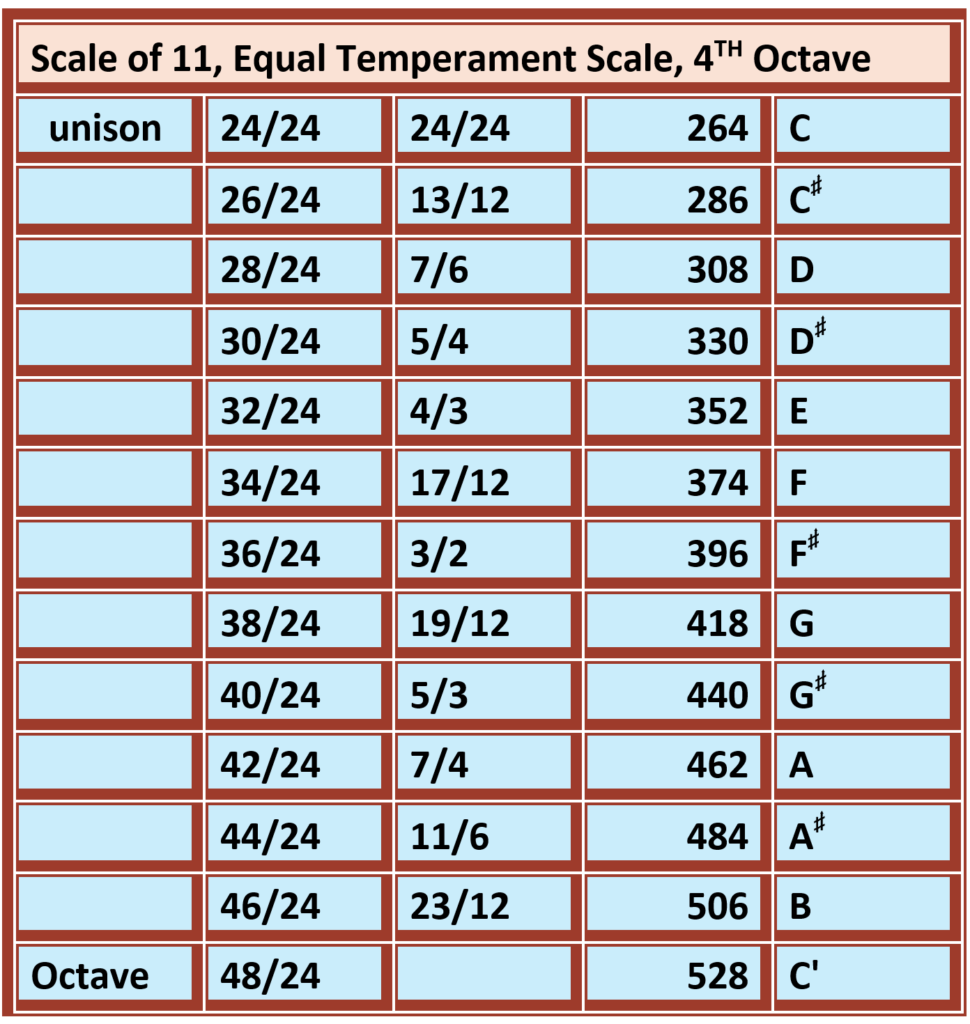
When building the Scale of 11, the first thing I noticed was an Equal Temperament scale in the 3rd octave with intervals of 11.It is not our Western Equal Temperament (ET), but it is an Equal Temperament scale. Below is this same scale in the 4th octave with intervals of 22.
The next chart shows the Quartertone scale of 11 with the Just Diatonic Scale highlighted, showing two more scales within the Scale of 11. (Note: when a QT interval name is also defined, then it is not shown in the first column, only the name of the ratio is shown.) Colored bars denote the diatonic scale, and the Adjusted Just Intonation scale.
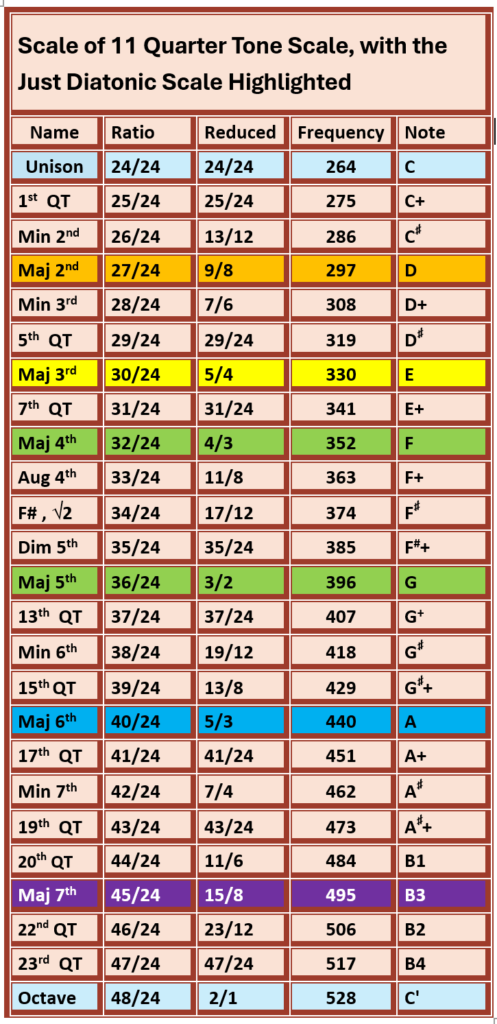
What emerges is not just a scale, but a structured field. Every frequency, every interval, and every relationship is governed by the same numerical principle—multiples of eleven.Within this Within this structure, familiar scales appear as expressions contained within it.
The Scale of 11 defines the harmonic field. The next step is to understand how the Degree Key is connected to the Scale of 11.