
Part 5 of 5
Harmonic Decode Part 5
The Degree Key
In Part 4, the Scale of 11 established the harmonic structure. The next step is to follow how the Degree Key appears within that structure. By assigning numerical values to the phrases and aligning them with the scale, A consistent pattern begins to emerge—revealing additional notes beyond the standard twelve-tone system.
Mapping the Degree Key
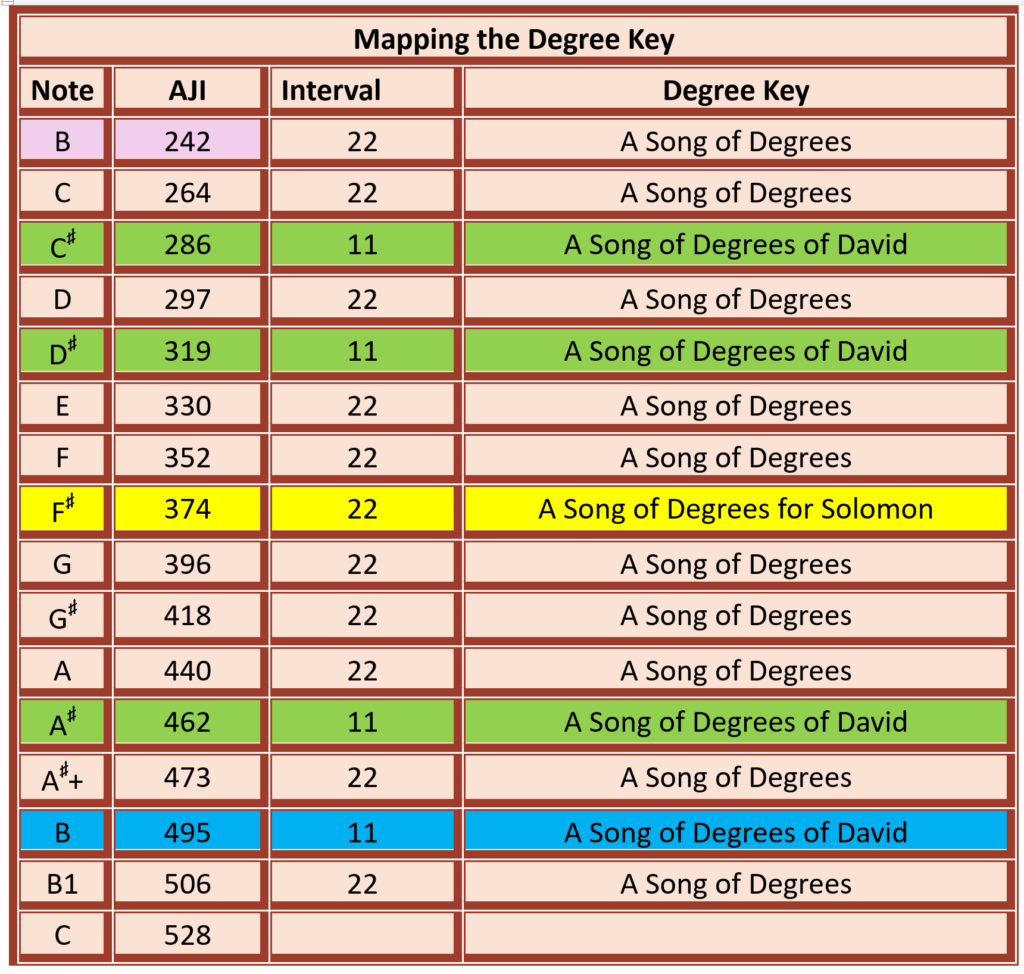
Now that we have identified the different scales (Equal Temperament (ET), Quartertone (QT), and Adjusted Just Intonation (AJI)), the next step is to determine how the Degree Key pattern appears within the Scale of 11 and the Adjusted Just Scale (AJI). From the earlier decoding of the clues, we determined that F belonged to “A Song of Degrees of Solomon.” The table below is a table for your reference.
We begin by matching the Degree Key pattern “A Song of Degrees for Solomon” to F𝄰 (Yellow line.) Using the Adjusted Just Scale, the pattern unfolded quickly through A𝄰 (462). This alignment lands “A Song of Degrees for David” with the interval of 11, 3 out of 4 times and they are all black notes. (Green line.) I then determined that the fourth occurrence (Blue line) must also be 11 even though it is a white note.
This then led to the conclusion that “A Song of Degrees” was 22. That left “A Song of Degrees for Solomon.” Even though this was a black note, the value was 22, that is why it had to have a different phrase. From this, the pattern is additive and not based on black and white notes or ratios.
In the Scale of 11 in Octave 4 (where we are working), I realized there were 5 possible values after 462. The AJI scale used only one, B=495, which is the standard B in the Just system. The possible values are: 473, 484, 495, 506 and 517. The Degree Key arrived at 462 by adding the 6th twenty-two to 440. The Degree Key mapping then finished by using the numbers already assigned to each phrase. The scale starting with 462 continues as 462 – 473 – 495 – 506 – 528. See the table below.
The last thing that stood out was the first phrase landed on B-242 (lavender), in the third octave. But there must be a frequency to add the interval to, and this becomes the starting point.
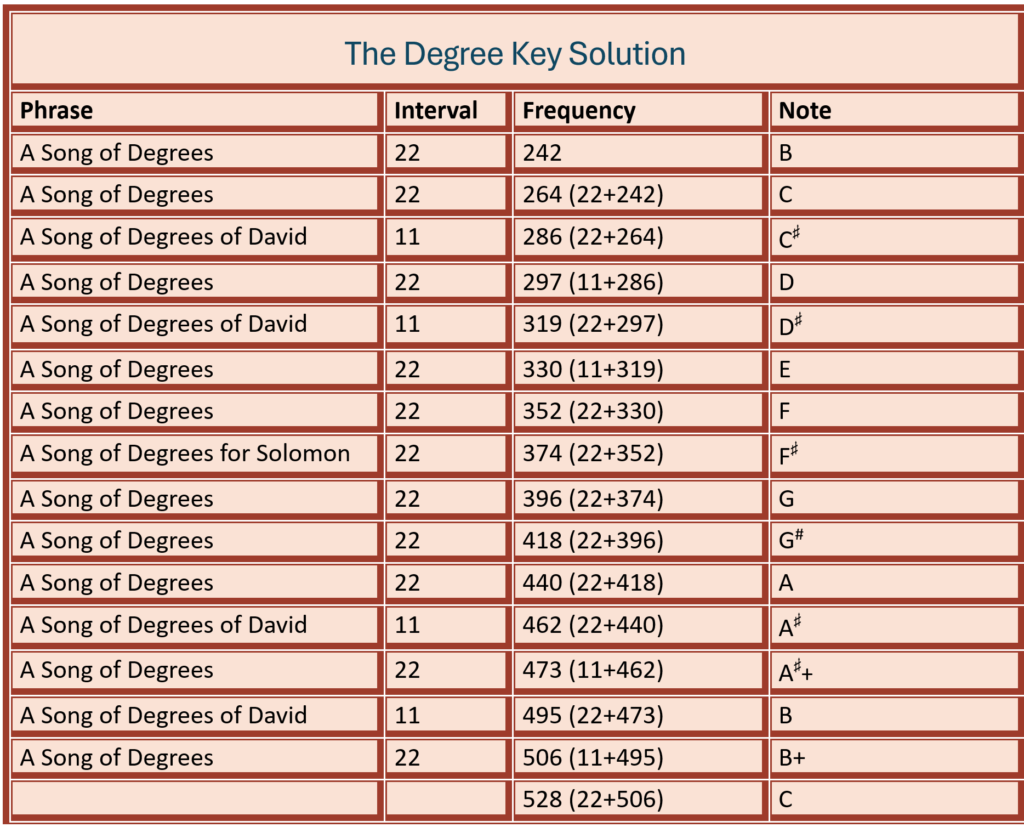
When matching the phrases, 11 and 22 indicate the next note. When aligning the clue to my scale, the first phrase landed on B below middle C, and I questioned why. Below is the solution I found. Because the phrases produce familiar musical steps, but do so through numerical addition rather than ratio-based relationships, the system was not recognized. Following the math, the value of the current note (B-242) is added to the interval (22) to arrive at the next note (C = 264). The C-scale still appears, but this first phrase reveals that the starting B (242) is not part of that scale, and two different B values (495 and 506) emerge. One is 495, which belongs to our Adjusted Just Scale and a value of 506 (or 253 in the 3rd Octave.) We also have an additional A𝄰 value (473), so adding these two new values (473 and 506), we have two new notes to make the 15-note scale.
Constructing the Degree Key Scale (RJS)
Now that the phrases have been assigned values, we can build out the scale. Beginning with B = 242 (2 × 11 × 11), the first interval added is 22. 242 + 22 = 264 = C. Then we take the next interval, 22, and add it to 264: 264 + 22 = 286. The next interval is 11, so we add 11 to 286: 286 + 11 = 297.
242 +22 → 264 +22 → 286 +11 → 297
In this way, the interval in each row is added to the frequency in that row to produce the next frequency. The movement still produces familiar musical steps such as whole steps and half steps, but they arise from adding numerical intervals rather than applying predefined ratios.
Expanding Beyond Twelve Tones
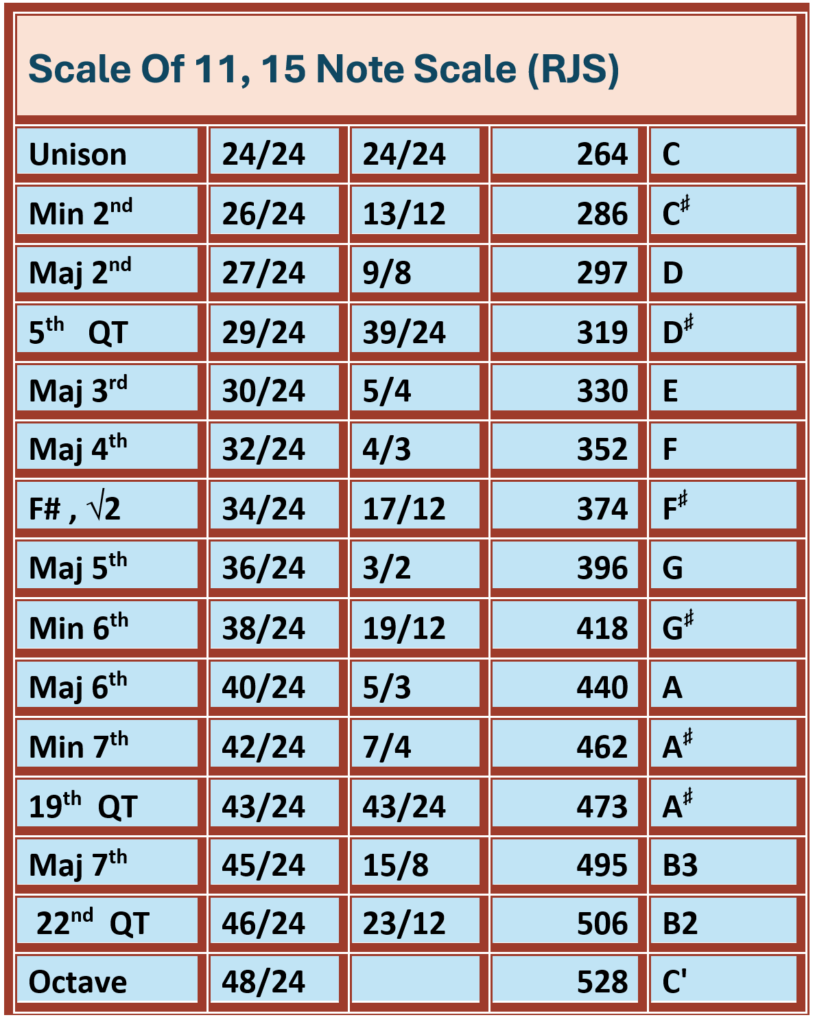
This reveals the new 15-note scale within the Scale of 11. This chart shows the 15 note Octave scale, highlighted in Light Blue. In the Adjusted Just scale, the last two intervals are 33. Each one has been divided into 11 and 22 in order to keep the pattern of only intervals of 11 and 22. This 15-note scale has been named the Resolved Just Scale (RJS).
So far, we have identified within the Scale of 11:
- An Equal Temperament scale (ET), (first appearing in octave 3)
- The 24-tone Quartertone scale (QT) (emerging in octave 4)
- An Adjusted Just scale (AJI), (found in octave 4)
- A new 15-note system (RJS) (also found in octave 4)
These are not imposed structures, but systems that arise naturally from within the field. It is likely that additional ratio-based systems are also present within the Scale of 11, including Pythagorean ratios (adjusted to a single octave), Lamdoma relationships (extending beyond the conventional 5-limit into higher prime limits), and possibly the ratios described by Archytas.
The Degree Key System
The Scale of 11 reaches structural completion at octave 4. At this point, all notes and intervals resolve to whole-number multiples of eleven, forming a stable harmonic framework. Beyond octave 4, the system expands through doubling. This creates finer divisions (microtonal refinement) without altering the underlying structure.
The Degree Key introduces a different function. It defines movement through the existing structure. This process can begin on any note from the frequency 242 forward. Once applied, the sequence continues without returning to a fixed octave position. Unlike traditional octave-based systems, where motion resolves cyclically, the Degree Key progression does not loop back to its starting point. In this way, the system behaves not as a closed octave loop, but as continuous progression. The system repeats, but at a higher level each time.

This distinction is critical:
- The Scale of 11 defines the harmonic space
- The Degree Key defines motion within that space
Because the motion is not constrained to octave repetition, the resulting behavior is best understood as a spiral.
Another important feature emerges in the higher octaves. As the octave divisions increase, more notes become available within the same octave span, yet the Degree Key pattern does not expand proportionally. Instead, it continues to select only a limited subset of notes from the larger field. By octave 6, for example, 96 notes are available, but the 15-note Degree Key pattern uses only the first 15 positions within the available octave structure. This suggests that the Degree Key is not defining the entire octave but tracing a specific path through it. Whether that path should then shift to the next available note in the octave and generate a new sequence remains an open question for further study.
Implications and Origin of the Clues
The role of the third clue becomes clearer. It not only introduces new numbers, it provides a way to understand how the system operates. The values attributed to Puleo point toward a structure built on whole numbers and consistent relationships. When those relationships are followed through, a coherent framework appears.
Within that framework:
- frequencies resolve to whole-number multiples
- intervals follow the same pattern
- harmonic relationships remain intact
This does not replace existing musical systems. It offers another way of seeing what they approximate.
The structure stands on its own. The system can be derived, observed, and verified directly from the numbers. However, the question of origin remains open. The translation of the King James Bible, where the clues were hidden, occurred during a period shaped by figures such as Francis Bacon and John Dee—individuals deeply engaged in cryptography, mathematics, and symbolic systems. Within this context, the structured and layered nature of the clues raises the possibility of intentional encoding designed to preserve information across time.
The Scale of 11 establishes the structure. The Degree Key shows how movement takes place within it.
What emerges is a system that continues to unfold—revealed through number, structure, and sound.